Saturday, March 17, 2012

Killer bees and a Honduran business development workshop


I’ve done a lot of business analysis exercises over the years, but never one where African killer bees showed up on the list of threats and opportunities.
I just spent two days in a Cuso International workshop for producers in Honduras, bringing together about 30 people to help them take a look at their businesses and what they can do to make them stronger.
On one level, it was familiar after years as a manager. It’s important to sit down and analyze your operations and the external factors, current and future, and come up with plans to do better.
On another, it was wildly different.
Most obviously, because everything was in Spanish. We did an early get-to-know-each-other exercise which included drawing a symbol for yourself. People did trees and suns and hearts and birds and the like. I did a question mark, because, I told them, I listened to the presentations and kept thinking “Que? Que? Que?” (Jody Paterson, my partner, drew herself leaping off a cliff. Her post on the workshop is here.)
But the challenges were also very different. The workshop - tallers they’re called here - included a few people from local NGOs, but mostly primary producers. There were several intense, darkly tanned coffee growers, some cocoa producers, furniture makers, fruit and vegetable growers and some women in a tiny honey business.
The program combined instruction with a lot of group work, with people joining others in the same field to study their businesses and do the standard SWOT analysis - strengths, weaknesses, opportunities and threats. Except here it’s a FODA analysis - fuerzas, opportunidades, debilidades y amenazas. They were seriously committed; we went from 8 a.m. to 9 p.m. the first day, and started the sessions at 7 a.m. the next day, because we were running behind schedule.
The theory was that, using the analysis and considering the “value chain,” they would come up with action plans to strengthen their businesses and get to work on them.
It was effective, and fascinating. A few things leapt out.
First, they mostly weren’t as sophisticated in their analysis as a comparable group of Canadian business people. I spent time with the vegetable growers as they did their FODA analysis, and there wasn’t a lot of talk about new markets and pricing strategies and branding.
But that was realistic. If you’re growing tomatoes in a region with limited transportation and few restaurants or even supermarkets, then branding strategies are just silly. You’re selling a commodity. You could find the nicest tomatoes and charge a small premium, but organic isn’t a niche.
That was another difference. In a similar Canadian exercise, based on my newspaper experience, people would have come up with grand strategies for new products and brand extensions and multiple platforms. They would have produced a plan that sounded oh-so-clever, but was actually completely unrealistic, designed to please their masters, not produce a stronger business.
The Honduran producers weren’t so delusional. Some of the action plans won’t work out, but they were pragmatic.
Second, the producers had a sound assessment of their businesses’ positions, and what needed to happen. The coffee growers knew they needed to improve living conditions for workers, or they wouldn’t have enough of them, so their plan included better housing and food. (They also raised interesting questions about organic and fair trade certifications. These are family operations, but if their kids help with the picking they lose their fair trade certification. And more broadly, work harvesting coffee by kids keeps a lot of families out of desperate poverty. Is it really “fair” to cut them out of that work without any alternative? A school-aged boy can make $15 a day picking coffee, three times the wage for an unskilled labourer and as much as a bank teller. For a poor family, that’s a huge benefit.)
The rambutan growers knew they needed to come up with products based on the fruit. (I’d never heard of it, but rambutan is a cool-looking Asian fruit that is, according to Jody, like a lychee without the disgusting floral flavours.) Their plan included exploring wine and marmalade products, though the concept of opening export markets seemed remote.
Third, the barriers to success were often, by North American standards, small. A way of getting goods to buyers - as simple as an available truck, or car in the case of the honey producers - came up on several lists.
And fourth, the importance of the support of NGOs was overwhelming. The action plans included investments in processing equipment to add value, or technical improvements to increase crop productivity. They looked to NGOs to support those efforts.
Some argue aid encourages dependency. But North American agricultural producers benefit from a huge amount of aid - university agriculture departments doing research, government ministries providing experts and funding and marketing support (and in the case of marketing boards, protection against competition).
That doesn’t exist in Honduras. There’s no money. Agencies supported with foreign money provide the technical and financial support Canadian producers take for granted.
The vegetable producers dragged me into the group photo and made me sign the official pledge to deliver on their action plan.
I’ll let you know how it went in six months.
Footnote: And I hope the African killer bees don’t wreck the honey business. They killed two children here last week, when the eight-year-old brother of one ill-advisedly threw a rock at a hive in a tree. We are not in Kansas anymore, as Dorothy would say.

Christy Clark decides to be more like Gordon Campbell

Lively read from Harvey Oberfeld on the controversy over Christy Clark's refusal to take questions from the media at a Vancouver photo op, and new communications director Sara MacIntyre's snark-laden on-camera exchange with reporters over the question ban. (Snark-laden on both sides.)
The control-freak approach to avoiding questions from journalists or unscripted exchanges with the public is popular these days. Stephen Harper - for whom MacIntyre did similar work - is a big fan. And he is also prime minister, which might lead some to think it's not a bad tactic.
Not so good for democracy though. Though it's fair to question our performance, reporters play an important role in asking questions that the public might want answered. No one anointed the media as public representatives, but it's part of the checks and accountability of our system and not lightly to be abandoned. (And, theoretically, if the news media ask all the wrong questions people will quit paying attention to them. Which, in fairness, I note they are.)
The alternative is politicians spouting scripted platitudes and talking points.
It's an odd approach for Clark to choose. Her record in government wasn't impressive, but Clark's leadership campaign was based in part on her abilities as a politician, which had been highly rated. Her radio background and personable nature were supposed to make her an effective communicator, able to perform well in challenging situations.
Turning her into a politician like Gordon Campbell or Stephen Harper, sticking to stiffly scripted set pieces in staged settings, tosses away what was claimed as a major political asset.
The increasing distance between politicians and the people they represent, which looks much like dislike, is also damaging for democracy.
As premier, Glen Clark, like those before him, was scrummed regularly by reporters. When the legislature was sitting - a less rare event in those days - the Press Gallery pack could usually count on one or two chances a day to pose questions. Clark also wandered the legislature lawn, talking, sometimes arguing, with people.
Campbell ended all that. He wouldn't stop for questions in the hall, no matter how pressing the issues.
Instead, he introduced what the press gallery types called secret scrums. Reporters were summoned to the premier's office infrequently and waited for Campbell to emerge from an inner office and stand in front of flags and take questions. At any moment he could wave a cheery thanks and bolt away, avoiding tough topics. Campbell also wasn't one for walkabouts, since RCMP officers accompanied him for security. (Though it's hard to imagine Clark having much less need for security by the end of his time as premier.)
Of course, Campbell won three elections, so maybe the tactics work politically.
But at the same time, voter contempt for, or at least disinterest in, politics and politicians, seems to be rising.
Winning elections at the expense of a diminished democracy seems a bad trade for any responsible politician.

Footnote: In the video, MacIntyre claims that there was no release from the premier's office saying the premier would be available.
That wasn't true. Journalist Jeremy Hainsworth notes the Office of the Premier did issue an advisory at 5:34 p.m. on March 13 that said "The event will be held indoors, and photo and interview opportunities will be held after the Premier's address on the trade show floor."
Which suggests level of disorganization in the premier's office, perhaps the result of too many highly paid people rushing around each thinking he or she is in charge.
MacIntyre's testy and inaccurate response also suggests a certain panic. I did a weekly piece for Shaw TV on B.C, politics and policy and frequently had MacIntyre on, when she was the Canadian Taxpayers' Federation rep, to offer commentary. She was excellent, prepared and poised on camera and offering useful perspective. Not at all like in the unfortunate clip.
a

The importance - and potential corruption - of microcredit

I spent the last two days at a workshop for small producers, mostly agricultural, in Honduras. (I'll write something in the next day or two; it was interesting, even as I drowned in a 13-hour day of Spanish immersion.)
But a key issue was access to capital, even in tiny amounts. Doug Saunders' microcredit piece in the Globe today offers a useful perspective.

Sunday, March 11, 2012

Digging a hole with the Christians of Tyler, Texas


Great news, my partner said. I'm going along with a church group doing a water project to see how it works, and you can come.
CASM, the Honduran agency Jody is working for, was helping the group with the logistics. She thought it would be good to see the work, and maybe there would be a communications piece in it.
So at 8 a.m. Saturday we walked up to the Hotel Puente Maya, met a bunch of Texans and hopped in the back of a pickup truck. We dropped about half a dozen of them - and six or seven boxes of medical supplies - at the clinic in Santa Rita de Copan, where they were offering free care to all comers. (They had medical skills; it wasn't totally random.) It was market day in Santa Rita, and teens from the local school were on hand to help with the clinic, which is on the attractive, well-planted square. I practised my Spanish with a happily drunk old guy; in fact, my Spanish seems particularly well-suited to genially inebriated people.
Then back in the truck, and probably 90 minutes of steady climbing, on dirt roads, high into the mountains.
At considerable speed. Merlin, Jody's boss, was driving and he has the skills and commitment of one of those Finnish WRC rally drivers. (That is, for non-motor sport fans, high praise.)
We crossed streams, had stunning views, passed tiny houses and small towns and ended up at La Cumbre, way up in the mountains, a community of houses strung along dirt roads and trails. Up one of the trails through a coffee plantation - they are great looking plants, dense bushy, dark green foliage - and we came to the project.
Which was a hole in the ground, a medium-size hole in the ground at this point. The community water system had a reservoir higher up, but it wasn't large enough. The good people of the First Christian Church in Tyler, Texas, were here to fund and help build a second reservoir to ensure the community didn't run out of water when things got dry. The two tanks and the village would be connected with piping when it's done.
The reservoir was being dug into the hillside. It was to be a circle, about 20 feet across and four or five feet deep. That meant though, because of the slope, that the wall would be about five feet tall on the downhill side and 15 feet tall on the uphill side.
Some people from the community had been working on it. It was probably two feet deep. The Texans - a mixed group, from maybe early 30s to nearing 70, I'd guess - grabbed shovels and pickaxes and started moving dirt. There was one wheelbarrow and a narrow dirt ramp to get it out of the hole. (The kind of useful thing I would have forgotten to leave.)
So we dug too, of course. It would be remarkably lame to watch a bunch of Americans and Hondurans digging a community water project.
It was hard. The views were great, and we were high enough in the hills that it wasn't roasting hot. (Which is one reason it's such good coffee country.) But wielding a short, heavy pickaxe and trying to heave dirt out of a hole isn't easy.
The Hondurans were the strongest. They do this kind of work. But some of those Texans were real workhorses. One guy just settled into part of the hole and worked his way steadily downward.
I held my own, though I started too fast and then faded a little. And my one run at pushing the hugely heavy wheelbarrow out of the hole convinced me that perhaps that was best left to others.
A woman from the community and two young girls brought us lunch - tortillas, refried beans, spaghetti and scrambled eggs - and by the time we called it a day the hole was pretty impressive - another two feet deep, I'd say. We moved way more dirt than I thought we would, though I noticed people got quieter as the day wore on.
The Texans were taking Sunday off, but figured the hole would be dug by the end of Monday and pouring the concrete - also a hand-mix, wheelbarrow operation - would be next.
I was impressed with those people. They worked with varying amounts of strength and dedication, and occasionally seemed a little irked with each other, but they made a big dent in the reservoir, stayed in good spirits, joked with the Hondurans and welcomed a couple of Canadians hanging around. They held a bunch of fundraising events to get enough money for the supplies and worked with a religious organization in the U.S. that links volunteers and projects.
And they were impressively realistic, perhaps because some of them had been doing this kind of thing regularly for about 20 years. Some projects worked great, they said, some only got partly done, one or two had not really turned out. But they showed up, accepted whatever living conditions were at hand, worked hard during their stay and left having accomplished what they could.
Outreach, they call it, and the First Christian Church in Tyler has had a longstanding commitment to use 10 per cent of the money that comes in to help others, in their community or anywhere they see a need they can fill.
I even liked the church motto - Unity in matters of faith, diversity in matters of opinion, in all things love.
It was a good day.

Thursday, March 08, 2012

Cracks in the Central American drug war front


It's been a big news week in Honduras. Joe Biden was in town.
And what everybody wanted to talk about was the war on drugs. Some wanted to talk about giving up on it.
The U.S. vice-president flew into Tegucigalpa for meetings with Honduran President Porfiro Lobo and the heads of Central American countries. (Well, not actually into Tegucigalpa. The U.S. Air Force has a big base without about 500 troops in Comayagua - the city where the prison burned - and Biden landed there. I don't blame him. The Tegucigalpa airport, with hills around, offers one the the world's scarier landings, including a sharp turn 45 seconds before touchdown. It's not a bad metaphor for arriving in Honduras.)
The war on drugs looks a total botch-up from North America, as I've argued in the past. Wasted money, increased gang activity and petty crime, higher prison costs and zero success. Only a fool keeps doing something when, decade after decade, it's not just ineffective but destructive.
That's nothing compared to the view from the countries that are on the front lines of the war on drugs.
For them, it's a real war, not a catchy political slogan. The drug war in Mexico - fought largely at the behest of the U.S. - has claimed about 50,000 lives in six years - civilians, police, justice officials, traffickers, tourists. The U.S. lost one-tenth that many troops in the Iraq war and people were unhappy
Honduras, largely due to fights over the drug transport business, had the highest murder rate in the world last year, at almost per nine per 10,000 people. About 60 per cent of murders - 4,400 last year - were linked to the drug trade.
The U.S. has been chipping in some cash - about $361 million to Central America since 2008, La Prensa reports.
But every year in that period, more people died, more drugs moved and crime and corruption increased.
None of that should be surprising. A UN study estimated the North American cocaine market at $38 billion in 2008. The U.S. says 79 per cent of South American cocaine lands in Honduras on its way to North American consumers.
Honduras total GDP is about $15 billion. The chance to make money handling and shipping a high-value product is hugely attractive. The need to fight anyone who gets in the way - other drug shippers, or police - is part of business.
It is, La Prensa, noted in an editorial before Biden arrived, simply a principle of capitalism - that where there is demand, in this case North America, there will be supply. The money, in a poor country, is irresistible even if the risks are great, for the drug shipment kingpins and the people who can earn a few hundred dollars carrying loads from Copan over the hills and into Guatemala. That much, surely, has been established over the years.
Guatemalan President Otto Perez Molina came to the summit promoting an end to the war drugs. Legalize drugs, says the former army general, including the transhipment. Tax and regulate and arrest those who who operate outside the rules. Let the U.S. work harder at reducing demand with treatment, education and innovative approaches. (That's one of the criticisms here, that the U.S. is asking other countries to tackle supply, at great cost, while doing nothing to reduce demand. Hard to argue given the record and, for example, the lack of available treatment options, in Canada.)
Reaction was mixed, but the leaders of Costa Rica and Honduras said the proposals should be discussed.
The alternatives all look grim. Escalating the war on drugs, as in Mexico, means more deaths, more violence and, likely, more corruption. The Honduras Weekly reported that the head of the Honduras' National Council Against Drug Trafficking warned drug trafficking groups are funding candidates to consolidate their power in next year's national elections. A Liberal party presidential hopeful said there are already "narco-congressman and narco-mayors."
In Washington this week, Gen. Douglas Fraser, head of U.S. southern military command, said the U.S. expects "the military in Guatemala, Honduras and El Salvador will continue to play an important role in domestic security in coming years." That too makes many people nervous in countries were democracy is a fragile thing.
Biden flew home after photo ops and meetings pledging that the U.S. would not waver in its war on drugs, despite its utter failure. (OK, he didn't say that last part.) Central American leaders seemed onside, for now.
And it's hard, given the state of U.S. politics, to imagine any intelligent, evidence-based discussion of drug policies.
But Guatemala's position on legalization, the willingness of some other countries to consider a new approach and the horrific toll being taken may signal that change is coming. Painfully slowly, but coming.

Note: Cartoon from La Prensa.


Tuesday, March 06, 2012

Government, union both to blame for the school mess

There has been a remarkable amount of vitriol from those who blame the current educational mess on the Liberal government or the B.C. Teachers' Federation.
The reality is they are both to blame. They have proven incapable of real collective bargaining for decades. Both now appear to like the irresponsibility of sham negotiations, a battle for public support with accompanying posturing and a legislated contract.
And, as I noted in this column a year ago, both have had at more than five years to accept sensible proposals that would have created the possibility of effective bargaining.


Both sides to blame for coming teachers' strike

March 25, 2011


We're heading toward another teachers' strike in B.C., and parents and taxpayers should be angry at the government and the B.C. Teachers Federation.
The bargaining relationship - or non-bargaining relationship - between the union and the government is needlessly destructive.
Worse, the parties - the BCTF, the school employers bargaining association and government - seem incapable of taking the basic steps to fix it...

This is all especially discouraging because the parties have been offered two different approaches that could avoid a pointless deadlock.
Vince Ready, asked to look into a 2006 dispute, recommended a new bargaining approach for this round.
Both parties should establish their objectives eight months before the contract expires, he wrote. That would have been last Sept. 30.
A facilitator/mediator - either agreed to by both parties, or appointed by the labour minister - should then immediately begin to meet with them in negotiating sessions, and where helpful make recommendations. A senior government representative should be at the table. And the parties should develop an agreed on statement of facts about the current situation - cost of compensation and benefits, recruitment issues and the rest.
Don Wright, who reviewed bargaining in 2004, recommended another approach. If negotiations failed, he said, a third party should conciliate. If that didn't work, union and employers would submit their best offers and the conciliator would pick one to form the new collective agreement.
Instead, the negotiations are heading down the same pointless path...

It's not too late. The parties could adopt Ready's approach and start realistic talks. The government could stick with its no net pay increase mandate. The union could win a commitment to cut class sizes and provide more preparation time. They could bargain.

Saturday, March 03, 2012

Bulging classrooms, Canadian jobs, and a $17 watch on the installment plan: Honduras by the newspapers


I'm reading the Honduran newspapers every day - either El Tiempo or La Prensa - to work on my Spanish and learn about the country. Some days, I'm not sure how well either effort is going.
It's tough to read when at least one word per paragraph sends me to the Spanish-English dictionary, which often doesn't really help.
And understanding the country is a work in progress. El Tiempo had a story today about parents in San Pedro Sula protesting because there were 93 kids in a Grade 2 class.
That's extreme, even by Honduran standards, although in rural schools wild overcrowding is the norm. In conversations, teachers and parents have described schools in pueblitas with 70 students in four or five grades, one teacher who may or may not show up and few supplies.
But San Pedro Sula is the big city, and the parents were mad.
But the story still left me baffled, even after my fallback of finding it online and running it through Google Translate.
The reason there are 93 children in the class is that two teachers haven't shown up for work since school resumed last month, so classes are doubled up. One has "personal problems," the story quoted a parent. The other one, a vice-principal, is inexplicably absent. The principal said the teacher had said "not even Porfiro Lobo (the Honduran president) could make me go there." (My translation.)
The principal wants another teacher assigned to the school. But the story was unclear on why the Grade 2 teacher wouldn't go to work, or whether she was getting paid or what the heck was going on. (I have been wondering whether Canadian news stories would be equally baffling if I didn't have my own knowledge to fill in the blanks in reporting.)
The teachers' unions, with 60,000 members, are a big political force. (And the BCTF is a strong supporter.)
I don't know enough yet to have any informed judgments. I do know that parents I've spoken to are fed up with job actions that have meant students have missed more than half the promised 200 instructional days some years, that anyone who can choses a private school and that the public system is poorly managed.
And I expect to find out more in the months and weeks ahead.
Canada also made today's El Tiempo, one of a few references since I've been reading. (One was an entertainment brief on a plan by one of the Falling Wallenda family to walk a tightrope across Niagara Falls. The other was an advance on the Canada-Hondura World Cup qualifier in June; if Canada wins (unlikely) I'll be staying off the streets for a few days.)
Today the story is about the lineup of Hondurans applying for jobs in Maple Leaf meat-packing plants in Canada. The jobs are part of the rapidly expanding temporary working program that lets companies bring in foreign workers to do jobs Canadians won't, or at least won't for the salaries the companies want to pay. (It has always seemed a contradiction. Business groups argue the market should set wage rates, except when they would have to pay more. Then they want to bring in desperate workers from low-wage countries.)
But it's important here. There are up to 200 jobs for people willing to cut up hogs and cattle. If you're under 35, have a secondary education - roughly our high school - some English, three years of physical work, good physical condition and no criminal record or past illegal immigration, then you can apply and Maple Leaf's representatives will make the selections. If you're good in the first year, you might be able to bring your family for the second.
The newspaper quoted two applicants. A 25-year-old single mom is ready to leave her daughter behind after two years of unemployment. A 27-year-old chartered accountant who has been looking for work for a year figures processing meat might offer a good chance to work in Canada. The newspaper photo, at the top of the post, showed a long line of the first of nine days of receiving applications.
The pay is good by Honduran standards - $1,921 a month, $443 a week. Live frugally, and you can send a lot of money home to help family here.
Which people do. About 19 per cent of Hondura's GDP is remittances from people working abroad, legally or illegally. Without that money, the GDP per capita would drop from $4,200 to $3,400 - a huge blow. The U.S. anti-immigrant rhetoric could mean economic disaster here.
Finally, I was amazed by 14 pages of ads from Key Mart, a big and opportunistically named retailer. Most stores sell on time here. When we bought our $125 dresser, we had the chance to make two or three payments, for a price.
But KM, as its logo reads, takes the idea to a new level. It advertised, for example, a backpack for $10.75, and offered to let you make 12 payments of 90 cents each. A $17 Casio watch could be yours today for the promise to make 12 payments of 96 cents. (The store sells much expensive stuff too.)
What was striking is that these were offers for people considered good credit risks. You can imagine how poor people are who don't qualify and can only dream of being able to afford a new Sarten frying pan that would cost 68 cents a month.
I won't buy a paper tomorrow. I've too much still to figure out from today's edition.


Friday, March 02, 2012

Krueger's attack on courts a dangerous smear

Maybe Liberal MLA Kevin Krueger should try to be an elected representative in Honduras. His lack of understanding of the importance an independent judicial system might play better here.


I keep being amazed by synchronicities between Canada and Honduras. This time, it's on justice.


Krueger, in a rambling 30-minute speech supposedly on the budget in the legislature this week, launched a sleazy attack on judges and the judicial system.


MLAs, like anyone else, have the right to opinions, no matter how uninformed.


But when they speak in the legislature, their remarks should have some foundation in fact, and they should have some evidence for their claims.


Krueger called it “outrageous” that child-luring charges against a man were stayed in provincial court because of a 27-month delay in bringing the case to trial - more than twice the time the Supreme Court of Canada said constitutes an unreasonable delay that violates the accused’s right to a fair trial.


“We all know what happened,” Krueger said. “We had a judge recently saying that he let an accused child offender leave his courtroom, and he made political statements about this being because the government is not funding them properly. That is horrendous. I would rather have a guy shake me down on the street for money than let an accused child offender walk, with the prospect that he might offend other children. I was absolutely appalled. It's outrageous.”


What’s outrageous is Krueger’s allegation that the decision was not based on the law, but on politics.


If he has any evidence, a single shred of evidence, he has an obligation to file a complaint with the judicial counsel of B.C., which investigates wrongdoing.


If he doesn’t, if this was simply a smear, and he has an equally great obligation to apologize for such damage to the judge and damage to the court system. (And Premier Christy Clark has a duty to remove an MLA who behaves so badly from the Liberal caucus.)


It is outrageous the charges were stayed because of the long delays. It’s outrageous the alleged victim and family spent 27 months without resolution and that the charge, not proven, will hang forever over the accused.


And it's outrageous B.C. courts lack the resources to deal with cases expeditiously, and that police forces face the same critical problems.


The key officer involved in the case, whose clever online investigation led to the charges, warned more cases will be dismissed because police don’t have the resources to handle complex online sex offence cases. It took police investigators 14 months to complete a full report to prosecutors in this case.


"You need more people," Det. Mike MacFarlane told CTV News. Though perhaps Krueger would argue that the officer also is lobying and doesn’t care enough about bring sex offenders to justice.


Krueger went on. He accused judges of “politicking from the bench.” They should “stop whining about how many judges there are,” he said.


While there many good judges, Krueger said, “There are some real bad apples. If you've been doing your reading,” he told the opposition. “you'll know about those and some of the outrageous things that they have said and done.”

“We have some real problem people on the bench,” he added.


Again, no examples. If Kruger knows about “real bad apples” and “outrageous” actions by judges, he should file complaints and cite cases. If not, he should apologize.


Improvements to the justice system are needed, and the stakeholders have been far too slow to make them. Delays are unacceptable and legal costs mean the system is impossible to access for most Canadians.


But Krueger’s drive-by smear - until he provides evidence to support his allegations - is irresponsible. And, as he should know, unfair, since judges allow their decisions to stand undefended and don’t take part in public arguments with politicians or interest groups. If their decisions are seen to be wrong, they can be appealed.


We rely on an independent justice system to protect us from oppression by the state. It’s not a theoretical issue. The former NDP government would have bullied Carrier Lumber out of its rights without the courts to enforce the law; the Liberal government was checked in attempts to break the law in dealing with teachers and health care workers and the children's representative.


Which leads, finally, back to Honduras, where politicians unhappy with Supreme Court decisions that rejected some of their laws as unconstitutional violations of citizens’ rights are musing about curbing the courts’ power.


The Canadian justice system is far from perfect. But when politicians start attacking it, without any evidence, and argue they, not an independent judiciary, should determine the limits of citizens’ rights and guilt and innocence, we should be alarmed.


There are already too many countries where citizens fear arbitrary actions by the state, or powerful forces, with no protection from the courts.


Footnote: Krueger urged support for Court Watch and public vigilance over the courts. The Canadian organization of that name is focused on concerns about actions by government child-protection authorities, but the notion that citizens should be better informed about the work of the courts is sound. Call the government and ask when the court is sitting in your community and spend a morning watching.

Wednesday, February 29, 2012

Ministries' service plans deal with past failures by moving the goalposts

The Liberal government’s ministry service plans are supposed to provide accountable. They set out key goals, plans to reach them and - importantly - ways to measure or success of failure.


But since 2001, the measurements have been getting fewer. And when the government fails, it simply changes the targets.


Take the education ministry service plan, released along with the budget.


The performance measurements include the percentage of aboriginal students graduating from high school within six years of starting Grade 8.


Back in the 2008 plan, the ministry claimed it had measures and budgets in place to make real progress on the dismal educational success rate of First Nations students. The rate was 53 per cent in the previous year, the ministry said. But rise each year, to 63 per cent by 2010/11.


This year’s plan says the rate was 53.7 per cent in 2011/12. The goal now is 58 per cent by 2014/15.


That’s pretty disastrous failure to achieve the goals set out in the ministry’s own plan.


Or consider another important measure, the percentage of students starting kindergarten “developmentally ready” to learn. That’s a measure of their health and social, mental and emtotional development - a litmus test, if you like, of our success as a society in raising kids.


In the 2008 plan, the ministry reported 70.4 per cent of children entering kindergarten were ready to learn (down from 72.1 per cent in 2004). The plan, citing StrongStart centres and other measures, said that would improve to 75 per cent by 2010/11.


But the current plan reveals that only 69.1 per cent of students entering kindergarten were ready to learn last year - things actually worsened instead of improving. The plan still projects an improvement to 75 per cent. But now it will take until 2014.


Over in the children and families ministry, the service plan includes a performance measurement based on the percentage of children in the government’s continuing care who are at the right grade level for their age.


The percentage was 78.8 per cent last year; the plan calls for it to increase to 80.5 per cent by 2014/15.


But the 2009 plan set the level the previous year at 78.7 per cent. By 2011 it was to rise to 83 per cent.


So the plan failed. There was no measurable progress. And the goals have been cut back, rather than delivering on the commitment to make the lives of kids in care better.


It’s to be expected, and even welcomed, that ministries miss some goals. If they didn’t, that would be a sign that they weren’t setting challenging targets.


But it shouldn’t be acceptable just to move the goalposts any time there is a failure in achieving targets that the government itself identified as critical.


And all the service plans deserve a lot more scrutiny from public and media.

Monday, February 27, 2012

Learning Spanish, and about Honduras, through the daily news

UPDATE: Canada made La Prensa today, with a story that we're offering 200 two-year jobs in the meat-packing industry to Hondurans, who can apply over the next week. They pay $1,912 a month, and if Honduran employees' conduct is good, they can apply to have their families join you after a year.
That's a lot of money by Honduran standards, and with an ultrafrugal lifestyle in Canada would allow regular cheques to be sent back home.
Which is hugely important. In 2010, 19 per cent of Honduras' GDP was based on money sent back from people working, legally or illegally, in other countries.
It could also be argued that the Canadian companies are using the program to avoid paying fair wages to Canadian workers, but that's another debate.

I’ve been reading the newspapers here to improve my Spanish, and learn something about the country.
It’s slow work, but getting easier. I can appreciate the burden of illiteracy, as I consult the Spanish-English dictionary to pry open the sense of some new word, most of which have a confusing welter of possible meanings.

The task is made harder by the maddeningly complex writing style. One sports story had an 83-word lead, a tumble of subordinate clauses and asides ultimately wandering to some conclusion I never quite got.

As for understanding the country, I’m not sure how that’s coming. Today’s El Tiempo - one of three dailies available in Copan Ruinas, if you count El Diez, an all-sports newspaper - featured the usual crime stories. Two young men, 17 and 20, found in a construction site in San Pedro Sula, hands tied behind their back and shot in the head. Two other unidentified young men found apparently strangled and wrapped in sheets and dumped on another road in that city. There’s been a lot of that going around, the story noted, recounting five other bodies found dumped in various wrappings.

It was a typical day. San Pedro Sula has a dismal record for crime, with some 1,143 murders last year, about three a day. It has 1.2 million people, so if Vancouver had the same murder rate there would be about six new dead bodies every day. In Victoria, a daily murder.

La Prensa, the other paper we get, regularly runs a helpful two-page infographic map of San Pedro Sula, with little pictographic symbols showing where different crimes were committed in the previous few days. A kind of chalk outline drawing for murders, a handgun for armed robberies, a sedan for carjackings and so on. I’ll write about the theories of why the country San Pedro Sula has become so violent in a future post.

The big news was a cabinet shuffle. The president, Porfiro Lobo, fired the education minister, the religion and culture minister, the vice-minister of agriculture and the head of the state energy agency. The finance minister and a couple of others were fired or quit in the last couple of weeks.

It’s all a bit familiar. The education minister got the chop because he hasn’t been able to get a handle on the job. El Tiempo noted that after two years he still couldn’t say how many teachers were actually employed by the government. More significantly, the teachers’ union and government have been bickering for years, and parents are sick and tired of it. Last year, there were supposed to be 200 educational days, but there were actually about 80 due to protests and job action and study days and the like.

The energy corporation head was fired because he signed a long-term deal to buy electricity from an American company that looks suspicious. (Kind of a southern version of BC Rail.) Similarly, the agriculture guy was whacked because he signed a deal letting a couple of big shipments of rice into the country without the normal duty, irking the industry which relies on the tariff protection. Rice imports are a longstanding issue here, and critical in a country where cheap beans, corn and rice are all that keep many people from starvation.

And the religion minister was fired because he wasn’t considered sufficiently loyal to the president, as he failed to fight back when the Supreme Court ruled a recent law giving status, sort of, to evangelical churches was unconstitutional. The status only applied to churches recognized by a council, violating constitutional rights to religious freedom.

It’s puzzling. It seems power is centered with the president, but the firings suggest ministers have a lot of autonomy. Honduras has a republican system, with powers carved up between congress and the president. Practically, it’s a two-party state without much to chose between the Liberal and National parties.

Meanwhile, Lobo gave a speech and argued the Supreme Court has too much power and there should be a remedy when they get it wrong on the law, which sounds ominous to an outsider.

The best quote in the paper today came from the German ambassador, speaking at conference at the end of a visit by German justice officials.

It’s wrong to call the country a failed state, he said.

“I don’t believe Honduras is a failed state,” he said. “It’s a state that functions perfectly, in serving the interests of some.”


Footnotes: At one time, I might have felt a little smug about some of the governance issues here. But since the governing party in Canada was apparently helped to victory by systemic electoral fraud, subverting democracy, it’s hard to claim we have anything to teach others.

And the New York Times looked at crime in Honduras on Saturday. The piece is here.


Thursday, February 23, 2012

The inside scoop on home design trends


From the cutting edge of home decor....

We're settling in, happily, to the new digs in Copan Ruinas. On Tuesday, two guys with a truck showed up to add the kitchen storage unit pictured above.
I like it. And while I can't be certain, I'm predicting that by fall all the hot home decor magazines in North America and the TV show design gurus are going to be talking about the whimsical yet practical concept of combining storage with a subtle tribute to the Dadaists.
Remember, you saw it here first.

Footnote: Our other kitchen improvement this week was to add a red curtain underneath the sink, hiding the propane tank from view. Martha Stewart, eat your heart out.

Wednesday, February 22, 2012

The Falcon budget, or have the Liberals conceded defeat?


I can't resist a few comments on the B.C. budget from some 4,700 kms away
First, I wonder if the budget is the last for Premier Christy Clark. It shows no connection with what she claimed as her priorities as premier. The Families First agenda and B.C. Jobs Plan seem to have been forgotten much more quickly than Gordon Campbell's Five Great Goals and other enthusiasms. This appears to be very much a Kevin Falcon budget, and absent any other apparent direction from the premier's office, a Falcon government. Which raises the question of whether Clark will continue as leader into the next election.
Second, I wonder if the Liberals are already planning for defeat in the next election. Selling off the Liquor Distribution Branch is the action of a government that doesn't expect to be around for long. The Liberals looked at the idea in their first term, and despite legitimate questions about the whether government needs to be in the alcohol business, concluded the long-term benefits in terms of revenue from the Liquor Distribution Branch were too great to give up. Pragmatism trumped principle. Seeking a one-time benefit from the sale - and getting the deed done while they can - suggests the Liberals aren't that worried about the long term. (It also indicates a lack of true prudence. Using asset sales to cover operating costs simply means tougher adjustments lie ahead.)
More significantly, this isn't a credible budget past the date of the next election. The multi-year freeze on spending in almost all ministries might be manageable, at some cost to already inadequate services. But the budget calls for a three-per-cent increase in health spending, despite a growing population and rising care costs. That can't be done without major reforms and innovation, and the government has plans for neither. SImilarly, the budget projects a 15-per-cent cut in government employees from 2010 levels by 2014 - about 5,000 fewer jobs, with no apparent plan to achieve the goals without harming critical areas like public safety. (One of the Liberals' backward steps on transparency and sound management in the last few budgets has been to quit providing staffing levels by ministry, and offer only a global number, making it impossible to know where cuts are coming.)

Footnote: The Falcon budget made me think of his comment last month on the government's 19-month fight to keep the shredded HST sales pamphlet secret. “My direction to staff was really clear: just release the damn thing,” he said. Some took that as an attempt to rewrite history - if the minister really gave the order, they reasoned, why wasn't it done. But equally, Falcon could have bee stating that he did give the order, and was overruled by the premier's office, a quiet bit of insurrection.

Monday, February 20, 2012

Looking at the Honduran prison fire from Copan


I’ve been parsing my way through the papers, diccionario in hand, reading about the Honduran prison fire that killed 359 people on Valentine’s Day.
If you’re the praying kind, offer a quick prayer that smoke and fumes killed those poor bastards trapped in their overcrowded cells. The alternative, based on the grisly pictures, is too horrible to contemplate.
And if you’re the thoughtful kind, turn your mind to the lessons from this fire for those living in Canada and B.C.
Honduran prisons are, of course, far worse than the grimmest Canadian jail. They were built to house large numbers of people in small quarters, and then crammed with even more prisoners.
The Granja Penal de Comayagua, which burned last week, was built to hold about 400 prisoners. It held 852 when the fire broke out around 10:30 p.m., with six guards on duty who apparently couldn’t or wouldn’t find the keys to open cells.
Photos from other prisons show eight prisoners laying on three single beds pushed together in a cell, and others on towels on the concrete floor, all in heat that routinely is in the high 30s.
Based on the multiple theories on the cause of the fire, it’s unlikely that it could happen in Canada. (They are wide-ranging. An electrical fire was blamed, but the power authority claimed that was impossible. There were reports an inmate set his mattress on fire, shouting “Tonight we all die.” Some surviving prisoners say the fire was part of a plan to let 85 prisoners escape that went wrong, and that the prison authorities had been paid to look the other way. There are similar rumours, according to the papers, that the fire was part of a plan to kill an inmate that spun out of control.)
This was not new for Honduras. A fire in 2003 killed 107 inmates; another one in 2004 killed 66. (In the 2003 fire, many were actually shot by guards as they tried to escape the flames.) Neither, according to one columnist, has been properly explained.
But some aspects of the whole disaster would be familiar to Canadians.
The jails are overcrowded, in part, because of anti-gang legislation that aimed to put more people behind bars. (Maras, the gangs are called, and they are a huge urban problem.)
That’s made the jails more crowded, but it has done nothing to make life safer.
Which is just as true in Canada, where the government is determined to lock more people up, for longer periods, without taking any steps to fund the prisons or ensure they come out less likely to commit crimes.
B.C. jails are routinely housing double the number of inmates they were designed for. That doesn’t mean they are as horrific as Honduran jails. It does mean they are dangerous, for inmates - many of whom have not been convicted of any offence - and staff.
And it means they are warehouses where rehabilitation isn’t a priority. Inmates have little access to education or counselling or such basic courses as anger management or dealing with drugs and alcohol, and are released with no provision for housing and few other supports. Mental illnesses - hugely common among the inmate population - are untreated. (A 2007-8 study found 30.1 per cent of female inmates in federal penitentiaries and 14.5% of male offenders had previously been hospitalized for psychiatric reasons. You have to be very sick to be hospitalized for a mental illness in our health care system. In B.C. prisons, a study found 56 per cent of inmates had been medically diagnosed with a substance use disorder or a mental illness or both. This didn’t include alcohol abuse, fetal alcohol syndrome or developmental disabilities.)
The lack of supports and help, you could argue, is fine for the irredeemable offenders. But it’s stupid for the inmates who could have a reduced chance of re-offending with some skills, addiction services and support in avoiding the things that landed them in prison in the first place. The result is a vicious cycle of more and more prisoners, more and more jails, and more and more crime.
And in both countries, anyone in prison, for whatever reason, is seen by many as less than human. That's certainly the language of many politicians. And where language goes, action - or inaction - follows, whether in the form of overcrowding and no pretence of rehabilitation, or disastrous fires.
Canadians and Americans also play a big role in keeping Honduran prisons full. They buy the drugs - cocaine and crack - that are flooding through this country on their way to markets in the north.
There are vast amounts of money to be made in a dirt-poor country. It’s hardly surprising that drug transportation to meet the demand in North America is a large, violent and corrupting business. Cut the demand, or legalize and regulate more drugs along the alcohol model, and the crime problems and prison populations of Honduras plummet. (Though the economic impact would be damaging.)
All of which isn’t of much interest to the families of those men - and one woman, there for an illegal tryst with her boyfriend - who died in their cells on Valentine’s Day.

Footnotes: The B.C. auditor general just found two-thirds of offenders serving their sentences in the community may be failing to complete rehabilitation programs that have been assigned by probation officers. There aren’t enough staff to monitor compliance, so programs that might keep people from re-offending - and make the community safer - simply don’t happen, the Vancouver Sun reported. The number of offenders supervised by each probation officer has increased 28 per cent since 2005.
Mark Ungar offered a more informed commentary on the Honduran prison disaster in the New York Times.
The Honduran government has sportily agreed to help with funeral costs; the government of Taiwan has promised $100,000 to help the victims' families - about $390 each.
And the photo with this post, of a woman waiting for news of the fate of a family member in the Comayuga fire, is by Orlando Sierra of Agence France-presse.

Saturday, February 18, 2012

Full circle to our new place in Copan Ruinas


Sitting in our new place in Copan Ruinas, I’m struck by how far I’ve travelled to get back to where I started.
Our apartment has a table, two plastic chairs, a bed and one end table, plus a fridge and a stove that doesn’t yet work because the gas line can’t reach the propane tank. Jorge the landlord has to chip a hole through the brick work that supports the sink for the rubber line from the secondhand stove.
Today I bought some $33 speakers from Jeox computers, so we have music. They sound pretty good. (In an interesting twist, the Pine Family’s Horse Girl just came on as my iPod shuffled through songs; a fine piece from one of the best bands you probably haven’t heard.)
We’ll scratch up more furniture.
But in the meantime, the lineup matches, eerily, the sparse furnishings of my apartment when I arrived in Red Deer some 40 years ago. (All right, in 1976.)
I had one wooden kitchen chair, a table, a foam mattress on the bedroom floor, a steamer trunk that served as a coffee table, and a turntable and amplifier. No speakers; I listened to albums on headphones. The lack of mobility, and the need to change album sides every 20 minutes, were useful in making me treat music as something to pay attention to, rather than as a background soundtrack. (Though that is a fine and rich role.)
I ended up in Red Deer by chance. I’d driven west from Montreal, with a plan to spend three or four months hiking in the Rockies before heading back east, applying for newspaper work along the way and stopping in the first town where a newspaper would hire me. (My career planning has always lacked a coherent strategy.)
The drive west was bizarre. I’d bought a secondhand Toyota Corolla with a 1200 cc engine and an automatic transmission, an unfortunate combination.
It was my second car. My first was a 1961 Fairlane my grandfather, my mum’s father, gave me after he had an accident somewhere near his home at Lansdowne and St. Clair in Toronto, and decided he didn’t want to drive anymore.
It was a fine car, heavy and light brown, with a straight six, and could pass anything as long as there was a clear three-mile stretch to get up to speed. In its last year or two, rust had eaten a a hole in the floor in front of the back seat. In Montreal winters, water splashed in during warm spells and froze into tiny ice rinks when the temperature plunged. That would have been unpleasant for passengers, except the rear passenger door latch had ceased to function, so I tied a rope from the driver-side door to keep it from flying open when we went around corners. Sitting in the back seat was only an option if I untied the rope and had passengers willing to hold the door shut.
The Corolla, palely insipid, had less charm and even less power. I spent days driving across Canada - Sudbury and the northern shield stick in my mind - without passing a single slower vehicle, except for the occasional farm tractor lumbering along the shoulder.
Long days. I was camping. I had nowhere to be. But I was seized by a strange compulsion to keep driving. At 5 p.m., the sun sending long shadows across the road, I would vow to myself to stop at the next campground. But when the sign loomed, I found physically unable to touch the brake or turn the wheel. I still regret driving past a sign, somewhere north of Superior, that pointed to some petroglyphs. I am unlikely to pass that way again.
Back to the Red Deer apartment and its sparse furnishings. I hiked, by myself and with my brother John and my future and former brother-in-law Murray, in Banff and then bought a bad tie and set out to look for newspaper work. The Edmonton Journal and Calgary Herald both, foolishly, said no, but both also suggested the Red Deer Advocate. Those were days in which newspapers were thriving and journalists could leap from job to job. Sending people to the Advocate let the city papers keep an eye on them, and hire them away as needed. It was a good system.
So I rewrote a press release on an Underwood 5 typewriter, which had a sticker identifying it as the former property of the Edmonton school district, was interviewed and hired as night desker. (That deserves a separate post.) After six weeks in the Buffalo Hotel (another time worthy of a separate post), I found myself, most happily, in my apartment with almost no furniture, a few pictures cut from books - I remember a great shot of Bert Lahr playing Estragon in Waiting for Godot - and the Corolla in the parking lot out back.
I accumulated more stuff - concrete blocks and a couple of sheets of plywood to raise the foam mattress off the floor, a used couch, a house, another house, two more houses, and many things to fill them all.
And now I’m back where I started. Happily.

Postscript: Jorge chipped a hole for the gas line, and we bought two more plastic chairs and a dresser, dishes, and a watermelon, pineapple and bananas (and an $8 bottle of Honduran rum). Now if we can just find a sofa.
Lest things seem too grand, note that only the ground floor of the house is ours.

Monday, February 13, 2012

Visiting the ruins, and Mayan street hockey with real flames


I have come to Honduras and seen the future of hockey - or street hockey, at least.
An innovation borrowed from the Maya could add life to the game, and bring its long awaited breakthrough in the southern U.S.
We spent Saturday catching up on the Mayan presence in Copan Ruinas. It’s spectacular. The town’s name comes from the remains of the Mayan city and settlement about a kilometre outside town, a UNESCO world heritage site.
The principal site has pyramids, sprawling plazas, the residences of the elite and surreal carvings in much better shape than more northern sites. That’s because, according to Saul, our guide (and part-time rock musician), the rock here is less prone to damage than the limestone used in Guatemala and Mexico. Whatever the reason, the carvings - stellae and sculptures and features on the buildings - are fascinating in themselves, and have that powerful effect of taking you back to the reality that people were living here in these buildings, and producing this art, in a complex (and doomed) society 1,100 years ago. It provides, for me, anyway, a useful perspective of the significance of our own brief lives. (For a similar sensation, make the drive out to Carmanah and stand among those giant trees as the rain filters softly through their branches.)
The excavations continue (our new landlord is an archaeologist at the site), and some 5,000 ruins have been identified in the Copan valley.
The buildings aren’t as huge as some of the pyramids at Teohuitican and Chichen Itza, though still amazing, and the site has a spectacular setting, with the Copan River running a few hundred metres away and green hills rising all around, a mix of fields and semi-tropical forest.
We’ll be back to the ruins. We only saw a small portion, and I’m looking forward to visits in different seasons and times of day.
In the evening, there was a Mayan theatrical presentation in the square. It was supposed to start at 6, according to the poster I saw, but by 7 things were still being set up, meaning we had time to grab street food - grilled chicken for Jody, beef for me, served with refried beans, local cheese, a big pile of pickled vegetables and tortillas. Delicious, abundant and $4.50 each, with enough left to feed a couple of the skinnier dogs in the square (which is very skinny indeed).
The presentation started with drumming, a sounding conch shell and flute, as people in loin cloths and startling white face paint came into the square. There were ceremonies and a wordy - and for me largely incomprehensible - narration as the music went on.
Then six young guys in loin clothes and sandals, wielding branches shaped like hockey sticks, entered a rectangular space marked by an 18-inch-high fence of widely spaced branches. The crowd pressed around, as a priest, I assume, staged a small ceremony and then rolled a six-inch, flaming ball into the centre of the two teams. The object was to whack the ball into the other team’s end boards.
The moves were entirely like hockey, if hockey also involved avoiding burns, or setting your hanging loincloth on fire when the puck came your way. The ball was soaked in diesel or lamp oil, and lasted for five minutes before disintegrating, when it was replaced. Occasionally, it bounced out of the playing area and we leaped back, parents hauling small kids away from the flames. Sensible people would have choreographed the play. (Well, really, sensible people would probably question the idea of fiery hockey game in the midst of a crowd.) But these were teens with sticks, and they just wanted to win. It was better than most NHL games.
A few fireworks at the end of the show, and up the hill. I like this place.

Note: Peloto photo by Jody Paterson

Friday, February 10, 2012

Drowning in Spanish total immersion

There’s a certain amount of self-discovery tied into my current effort to learn Spanish, and reminders of past failings.
I’ve hurled myself into the enterprise. We’re doing four weeks at the Ixbalanque Spanish School here, which means four hours a day of one-on-one instruction, and a home stay to immerse us in the language. Total immersion brings, as you would expect, frequent feelings of drowning.
My Spanish is close to non-existent - enough to get by in frequent travels to Mexico, buttressed with some continuing ed classes half-heartedly attended a decade ago.
But now I am battling with conjugations and objectivos indirectos and an astonishing number of verbos irregulares. While, at the same time, trying to build a large enough vocabulary to be able to actually say what I’m thinking. And I’m trying to comprehend what now sounds mostly like a stream of syllables when people speak to me.
It’s humbling to trundle in each morning with my homework, and to stare uncomprehendingly as mi maestra explains fine points of grammar in Spanish. (The teachers mostly speak little English, and in any case won’t, as that’s part of the school’s approach.)
And it’s painful to be reminded so belatedly of my undistinguished early school career. I was always been astoundingly poor at memory work, as we used to call it. Partly, I didn’t care enough to bother. Partly, I am genuinely bad at it.
I am self-diagnosed with prosopagnosia - the inability to remember faces. I spent four hours a day for a week with my first Spanish teacher here, than failed to recognize her on the street 10 days later. When I was leaving a newspaper after three years for another job, I went through the building bidding farewell to my coworkers, although I had no idea who most of them were. That was established clearly when I thanked a guy in the mailroom for the pleasure of working with him over the last three years and he said he was just there for the morning to fix a machine. I think it might have undermined my effort for the people who actually worked there and witnessed the encounter. (My form, if it’s real and not just an excuse for a lack of interest in others, is mild. Oliver Sacks wrote in the New Yorker of walking past the psychiatrist he had been visiting three times a week for years, in the doctor’s office building, without recognizing him.)
Memorization isn’t a personal impossibility. Miss Mewha, my Grade 4 teacher at Willow Glen Public School, demanded my parents torture me for months with flash cards of the times tables. I’ve been eternally grateful. With a command of the multiplication tables and recognition that an approximate answer is good enough, you are more numerate than the vast majority of people.
And it is easy for me to retain facts that have a context. As a a manager, I could readily recall facts and figures about business performance, and I can do the same as a journalist when I’m immersed in a topic.
But learning Spanish means rote memorization. There’s no other way. I am plunged into a world in which my greatest weakness is a necessary competency.
The experience is also a reminder of another quality that bedeviled my early school career - a casual, unintended sloppiness. When Fernanda, this week’s teacher, goes through my homework, she finds errors in things that I know cold. I leave letters out of words as I race to complete the assignment, or use the wrong verb form even when I know the right answer. Fortunately, in this school, they don’t do report cards with comments like “Paul is not working up to his potential,” a frequent theme in the old days.
I persevere, even though some days the task seems impossible. These people have 14 different verb tenses. They have two very different verbs for to slap someone in the face, my partner noted the other day, apparently with slightly different meanings. We’re for a year or two and, I hope, will be in Spanish-speaking countries after that. I want to be able to talk with people about what’s going on in their lives, read the papers and do some reporting. (Carefully, as that can be risky here.)
And I’m liking the experience of being so far out off my depth. Like most people of a certain age, I haven’t faced a whole lot of totally new challenges in a long time. I’ve changed jobs and moved to new cities and travelled and raised kids.
But while those things were challenging, they mostly called for skills I had, or could acquire. I knew I could do them reasonably well. (Or I though I could, which is the same thing.
That’s true for most people. There are always new things to learn, but we tend to have the background and skill set to be pretty sure we can figure them out or fake them.
Learning Spanish isn’t like that. I’m struggling to get better, fighting my weaknesses, and, often, coming out on the losing side.
And it’s actually pretty good to find myself in the deep end, without knowing if I can swim. If nothing else, it’s an experience that focuses the mind in a most energizing way.

Sunday, February 05, 2012

Happy birthday, Ismael


There’s a lot that can be said about the downside of the home-stay experience. But I won’t say it; after all, nine-year-old Carlos is learning English and is Jody’s Facebook friend. (Though I did write about the noise here.)
But the upsides can be good too.
Ismael, Esmeralda’s husband and the patriarch of our three-family cluster, came home Thursday for his birthday weekend. He’s a big, burly cheerful guy with a greyish crew cut and a big smile revealing widely spaced teeth. Ismael fixes heavy equipment on road projects, and goes where the work is. Right now, he’s in La Florida, a town near here, and comes back every few weeks.
His birthday was Friday. The custom here is that you kick off the day with a noisy celebration to awake the birthday person. That meant fireworks in the street at 5 a.m., a blaring boom box and some accordion music from Jody for an appreciative Ismael, who seems a music buff. The neighbours seemed fine with it; people get up early here for work. (The morning celebrations can get even more elaborate; my Spanish teacher said here husband got the village futbol team to sing outside her window one year.)
The big birthday fiesta was yesterday. “Carne,” said Carlos happily.
We walked through the woods outside the ruins in the morning, went to the Tigo store and were told for the sixth time that USB Internet sticks would be in manana, sat in the square and then made our way up the hill home. It’s an impressive cobbled hill; people in the Barrio Buena Vista either shop in the neighbourhood or develop strong legs.
We went up on the roof, me to read on my Kobo, Jody to play accordion.
Marlene, a 10-year-old cousin who lives in Santa Rita, about five kilometres away, was here for the fiesta and came up on the roof, plunked herself in a little chair and listened intently to the music. After a while, she switched her attention to me and I had my longest sustained conversation in Spanish, on the price of my sandals, the Kobo, her school, my kids and a bunch of other topics.
It turned out Marlene is the sister of Deanna, the 15-year-old who lives with us and helps out around the house. Her father is dead, Marlene told me. He drank some beer, dove into a river and hit his head. (Jody heard the same story, without the beer reference.)
By then, preparations were in full swing. There was a giant piece of beef - probably three feet long and eight inches in diameter - that was being trimmed and cut into strips, and beans were cooking over the outdoor wood stove. A table and chairs were set up in the courtyard between two houses, where a car is usually parked.
I sat down outside the kitchen with Ismael, Carlos (the 10-year-old) and Jorge, his uncle, and listened, largely uncomprehending, to a serious discussion of the failings of Barcelona in its match that afternoon. Ismael offered me glass of Johnny Walker Black - he had what I took to be a birthday bottle, still in its cardboard box, beside him. Those are tough decisions for a stranger in a new land. Is it bad form to take the birthday’s special treat, especially when it’s a giant expense for people of modest means? Or it insulting to say no?
I balanced the cultural concerns with my fondness for scotch and said yes. But just one glass.
Meanwhile, Jorge had dragged out a homemade steel barbecue and started scrubbing the round grill with water from the pila. (Have I mentioned pilas? They’re big concrete water outdoor tanks, with an open top and a tap. On one side, there’s a ridged flat surface - like a washboard - for scrubbing clothes or washing dishes. The function is partly to store water for household chores for when the supply runs out.)
He dumped a bag of charcoal - real charcoal, not little briquettes, into the grill on top of a garbage bag, doused it in diesel and set it on fire. A styrofoam tub and another garbage bag were placed on top, plastic apparently being an approved accelerant.
A light was strung from the neighbour’s house - and then the power went out.
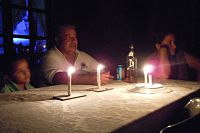
So candles and flashlights and an almost full moon provided light as guests began to arrive, too rapidly for me to figure out who was who, except for a couple of Ismael’s brothers. But I sat at the table, tried halting phrases, and smiled agreeably. The power came back on.
After a head-spinning visit, I checked out the barbecue, now laden with strips of marinated meat tended by Jorge. The meal - beans, beef, cheese, grilled green onions, salsa, crema and tortillas - was amazing.
The food and the guests kept coming, and Jody played accordion to an enthusiastic audience. By 10, we were fading and headed to our room. As we settled in, the Honduran music started up again on the portable stereo.
Except the trumpet rang through too clearly, too brightly, for a recording.
Luis, the newest son-in-law (he married Carena, whose husband had been murdered in San Pedro Sula) had gone done to the square and hired the mariachis who play on Saturday night to come up to the house. Trumpet, accordion, two guitars and one of those big-bellied accoustic six-string basses that anchor mariachi bands. The singers were good and the songs passionate, and they played for more than an hour.
By the end of the night, the Johnny Walker Black bottle was empty and Ismael happy.