Monday, February 13, 2012

Visiting the ruins, and Mayan street hockey with real flames


I have come to Honduras and seen the future of hockey - or street hockey, at least.
An innovation borrowed from the Maya could add life to the game, and bring its long awaited breakthrough in the southern U.S.
We spent Saturday catching up on the Mayan presence in Copan Ruinas. It’s spectacular. The town’s name comes from the remains of the Mayan city and settlement about a kilometre outside town, a UNESCO world heritage site.
The principal site has pyramids, sprawling plazas, the residences of the elite and surreal carvings in much better shape than more northern sites. That’s because, according to Saul, our guide (and part-time rock musician), the rock here is less prone to damage than the limestone used in Guatemala and Mexico. Whatever the reason, the carvings - stellae and sculptures and features on the buildings - are fascinating in themselves, and have that powerful effect of taking you back to the reality that people were living here in these buildings, and producing this art, in a complex (and doomed) society 1,100 years ago. It provides, for me, anyway, a useful perspective of the significance of our own brief lives. (For a similar sensation, make the drive out to Carmanah and stand among those giant trees as the rain filters softly through their branches.)
The excavations continue (our new landlord is an archaeologist at the site), and some 5,000 ruins have been identified in the Copan valley.
The buildings aren’t as huge as some of the pyramids at Teohuitican and Chichen Itza, though still amazing, and the site has a spectacular setting, with the Copan River running a few hundred metres away and green hills rising all around, a mix of fields and semi-tropical forest.
We’ll be back to the ruins. We only saw a small portion, and I’m looking forward to visits in different seasons and times of day.
In the evening, there was a Mayan theatrical presentation in the square. It was supposed to start at 6, according to the poster I saw, but by 7 things were still being set up, meaning we had time to grab street food - grilled chicken for Jody, beef for me, served with refried beans, local cheese, a big pile of pickled vegetables and tortillas. Delicious, abundant and $4.50 each, with enough left to feed a couple of the skinnier dogs in the square (which is very skinny indeed).
The presentation started with drumming, a sounding conch shell and flute, as people in loin cloths and startling white face paint came into the square. There were ceremonies and a wordy - and for me largely incomprehensible - narration as the music went on.
Then six young guys in loin clothes and sandals, wielding branches shaped like hockey sticks, entered a rectangular space marked by an 18-inch-high fence of widely spaced branches. The crowd pressed around, as a priest, I assume, staged a small ceremony and then rolled a six-inch, flaming ball into the centre of the two teams. The object was to whack the ball into the other team’s end boards.
The moves were entirely like hockey, if hockey also involved avoiding burns, or setting your hanging loincloth on fire when the puck came your way. The ball was soaked in diesel or lamp oil, and lasted for five minutes before disintegrating, when it was replaced. Occasionally, it bounced out of the playing area and we leaped back, parents hauling small kids away from the flames. Sensible people would have choreographed the play. (Well, really, sensible people would probably question the idea of fiery hockey game in the midst of a crowd.) But these were teens with sticks, and they just wanted to win. It was better than most NHL games.
A few fireworks at the end of the show, and up the hill. I like this place.

Note: Peloto photo by Jody Paterson
Friday, February 10, 2012

Drowning in Spanish total immersion

There’s a certain amount of self-discovery tied into my current effort to learn Spanish, and reminders of past failings.
I’ve hurled myself into the enterprise. We’re doing four weeks at the Ixbalanque Spanish School here, which means four hours a day of one-on-one instruction, and a home stay to immerse us in the language. Total immersion brings, as you would expect, frequent feelings of drowning.
My Spanish is close to non-existent - enough to get by in frequent travels to Mexico, buttressed with some continuing ed classes half-heartedly attended a decade ago.
But now I am battling with conjugations and objectivos indirectos and an astonishing number of verbos irregulares. While, at the same time, trying to build a large enough vocabulary to be able to actually say what I’m thinking. And I’m trying to comprehend what now sounds mostly like a stream of syllables when people speak to me.
It’s humbling to trundle in each morning with my homework, and to stare uncomprehendingly as mi maestra explains fine points of grammar in Spanish. (The teachers mostly speak little English, and in any case won’t, as that’s part of the school’s approach.)
And it’s painful to be reminded so belatedly of my undistinguished early school career. I was always been astoundingly poor at memory work, as we used to call it. Partly, I didn’t care enough to bother. Partly, I am genuinely bad at it.
I am self-diagnosed with prosopagnosia - the inability to remember faces. I spent four hours a day for a week with my first Spanish teacher here, than failed to recognize her on the street 10 days later. When I was leaving a newspaper after three years for another job, I went through the building bidding farewell to my coworkers, although I had no idea who most of them were. That was established clearly when I thanked a guy in the mailroom for the pleasure of working with him over the last three years and he said he was just there for the morning to fix a machine. I think it might have undermined my effort for the people who actually worked there and witnessed the encounter. (My form, if it’s real and not just an excuse for a lack of interest in others, is mild. Oliver Sacks wrote in the New Yorker of walking past the psychiatrist he had been visiting three times a week for years, in the doctor’s office building, without recognizing him.)
Memorization isn’t a personal impossibility. Miss Mewha, my Grade 4 teacher at Willow Glen Public School, demanded my parents torture me for months with flash cards of the times tables. I’ve been eternally grateful. With a command of the multiplication tables and recognition that an approximate answer is good enough, you are more numerate than the vast majority of people.
And it is easy for me to retain facts that have a context. As a a manager, I could readily recall facts and figures about business performance, and I can do the same as a journalist when I’m immersed in a topic.
But learning Spanish means rote memorization. There’s no other way. I am plunged into a world in which my greatest weakness is a necessary competency.
The experience is also a reminder of another quality that bedeviled my early school career - a casual, unintended sloppiness. When Fernanda, this week’s teacher, goes through my homework, she finds errors in things that I know cold. I leave letters out of words as I race to complete the assignment, or use the wrong verb form even when I know the right answer. Fortunately, in this school, they don’t do report cards with comments like “Paul is not working up to his potential,” a frequent theme in the old days.
I persevere, even though some days the task seems impossible. These people have 14 different verb tenses. They have two very different verbs for to slap someone in the face, my partner noted the other day, apparently with slightly different meanings. We’re for a year or two and, I hope, will be in Spanish-speaking countries after that. I want to be able to talk with people about what’s going on in their lives, read the papers and do some reporting. (Carefully, as that can be risky here.)
And I’m liking the experience of being so far out off my depth. Like most people of a certain age, I haven’t faced a whole lot of totally new challenges in a long time. I’ve changed jobs and moved to new cities and travelled and raised kids.
But while those things were challenging, they mostly called for skills I had, or could acquire. I knew I could do them reasonably well. (Or I though I could, which is the same thing.
That’s true for most people. There are always new things to learn, but we tend to have the background and skill set to be pretty sure we can figure them out or fake them.
Learning Spanish isn’t like that. I’m struggling to get better, fighting my weaknesses, and, often, coming out on the losing side.
And it’s actually pretty good to find myself in the deep end, without knowing if I can swim. If nothing else, it’s an experience that focuses the mind in a most energizing way.

Sunday, February 05, 2012

Happy birthday, Ismael


There’s a lot that can be said about the downside of the home-stay experience. But I won’t say it; after all, nine-year-old Carlos is learning English and is Jody’s Facebook friend. (Though I did write about the noise here.)
But the upsides can be good too.
Ismael, Esmeralda’s husband and the patriarch of our three-family cluster, came home Thursday for his birthday weekend. He’s a big, burly cheerful guy with a greyish crew cut and a big smile revealing widely spaced teeth. Ismael fixes heavy equipment on road projects, and goes where the work is. Right now, he’s in La Florida, a town near here, and comes back every few weeks.
His birthday was Friday. The custom here is that you kick off the day with a noisy celebration to awake the birthday person. That meant fireworks in the street at 5 a.m., a blaring boom box and some accordion music from Jody for an appreciative Ismael, who seems a music buff. The neighbours seemed fine with it; people get up early here for work. (The morning celebrations can get even more elaborate; my Spanish teacher said here husband got the village futbol team to sing outside her window one year.)
The big birthday fiesta was yesterday. “Carne,” said Carlos happily.
We walked through the woods outside the ruins in the morning, went to the Tigo store and were told for the sixth time that USB Internet sticks would be in manana, sat in the square and then made our way up the hill home. It’s an impressive cobbled hill; people in the Barrio Buena Vista either shop in the neighbourhood or develop strong legs.
We went up on the roof, me to read on my Kobo, Jody to play accordion.
Marlene, a 10-year-old cousin who lives in Santa Rita, about five kilometres away, was here for the fiesta and came up on the roof, plunked herself in a little chair and listened intently to the music. After a while, she switched her attention to me and I had my longest sustained conversation in Spanish, on the price of my sandals, the Kobo, her school, my kids and a bunch of other topics.
It turned out Marlene is the sister of Deanna, the 15-year-old who lives with us and helps out around the house. Her father is dead, Marlene told me. He drank some beer, dove into a river and hit his head. (Jody heard the same story, without the beer reference.)
By then, preparations were in full swing. There was a giant piece of beef - probably three feet long and eight inches in diameter - that was being trimmed and cut into strips, and beans were cooking over the outdoor wood stove. A table and chairs were set up in the courtyard between two houses, where a car is usually parked.
I sat down outside the kitchen with Ismael, Carlos (the 10-year-old) and Jorge, his uncle, and listened, largely uncomprehending, to a serious discussion of the failings of Barcelona in its match that afternoon. Ismael offered me glass of Johnny Walker Black - he had what I took to be a birthday bottle, still in its cardboard box, beside him. Those are tough decisions for a stranger in a new land. Is it bad form to take the birthday’s special treat, especially when it’s a giant expense for people of modest means? Or it insulting to say no?
I balanced the cultural concerns with my fondness for scotch and said yes. But just one glass.
Meanwhile, Jorge had dragged out a homemade steel barbecue and started scrubbing the round grill with water from the pila. (Have I mentioned pilas? They’re big concrete water outdoor tanks, with an open top and a tap. On one side, there’s a ridged flat surface - like a washboard - for scrubbing clothes or washing dishes. The function is partly to store water for household chores for when the supply runs out.)
He dumped a bag of charcoal - real charcoal, not little briquettes, into the grill on top of a garbage bag, doused it in diesel and set it on fire. A styrofoam tub and another garbage bag were placed on top, plastic apparently being an approved accelerant.
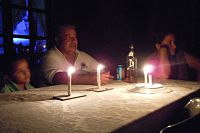
A light was strung from the neighbour’s house - and then the power went out.
So candles and flashlights and an almost full moon provided light as guests began to arrive, too rapidly for me to figure out who was who, except for a couple of Ismael’s brothers. But I sat at the table, tried halting phrases, and smiled agreeably. The power came back on.
After a head-spinning visit, I checked out the barbecue, now laden with strips of marinated meat tended by Jorge. The meal - beans, beef, cheese, grilled green onions, salsa, crema and tortillas - was amazing.
The food and the guests kept coming, and Jody played accordion to an enthusiastic audience. By 10, we were fading and headed to our room. As we settled in, the Honduran music started up again on the portable stereo.
Except the trumpet rang through too clearly, too brightly, for a recording.
Luis, the newest son-in-law (he married Carena, whose husband had been murdered in San Pedro Sula) had gone done to the square and hired the mariachis who play on Saturday night to come up to the house. Trumpet, accordion, two guitars and one of those big-bellied accoustic six-string basses that anchor mariachi bands. The singers were good and the songs passionate, and they played for more than an hour.
By the end of the night, the Johnny Walker Black bottle was empty and Ismael happy.

Friday, February 03, 2012

House-hunting in Copan Ruinas

We’ve been house-hunting, an experience I never liked in Canada. In Copan Ruinas, it’s so baffling it transcends unpleasantness.
For starters, there’s no simple way to look for places here. There’s no local paper or bulletin boards with apartment-to-rent ads. A handful of places have “Apartmento se renta” signs tacked up on doors, but not many.
The standard method is to ask anyone you can think of if they know of a place to rent, generally in Spanish, adding a layer of complexity. We’ve asked at the language school, in hotels and restaurants, called the local bilingual school that hosts teachers from North America, and asked the women running pulperias - the ubiquitous corner stores - in areas that looked promising.That’s part of the challenge - figuring out which areas look promising.
The first criteria is security. Copan, I stress again, is safe. But people are poor and every house has bars of some kind - often decorative - on the windows to prevent break-ins. As gringos, we’ll be presumed (not inaccurately in this conext) to be rich, and sometimes we’ll be away from home for a few days. Our new home needs to have good locks, a decent neighbourhood and, ideally, neighbours who will keep an eye on the place when aren’t there.
Then there’s the giant difference in basic standards between Canada and Honduras. We don’t want to live as if we were in Canada, even if we could afford it on a Cuso budget. It seems rude to come here and live way better than the people Jody will be working with, and foolish to live in a bubble that prevents us from understanding the place and the people who live here.
But housing here tends to be really basic. Partly, that’s simply a matter of money. Most people don’t have much. But there are also different cultural values. Decoration - even family pictures - is sparse to non-existent. There’s a tolerance for a lack of privacy that we don’t have. And things that would bug us on a daily basis - a shower head supported by a piece of string tied to the ceiling, bare florescent ceiling bulbs powered by a tangled web of wires and electrical tape, grimy walls - don’t seem to register.
And then there are the surprising issues. The municipal water supply serves most homes three days a week; you need a big enough roof tank to get through the times no water is available.
We’ve looked at half a dozen places, one twice when two different people guided us there. Several have been small - one room, or a room with a bedroom. One was a largish house, but in rough shape. A couple have been furnished, if a set of plastic outdoor chairs and a plastic table count. (Buying furniture presents another set of problems. We’ve found two “furniture stores,” both tiny and with four or five dressers, a couple of beds and two or three sofa, loveseat chair sets.)
Apartments have been cheap. Typically $150 bare, $250 furnished. And there seems to be little between cheap and way basic, and too expensive for us.
We’ve found one promising place, and have a few more to look at. (We stopped in at a German restaurant yesterday and asked about rentals today. They steered us to a house we’re going to look at today.)
And we’ve had a lot of generous help from people.
It matters quite a bit. Copan is beautiful and the people friendly, but we’re strangers in a strange land. A home that’s comfortable and secure is going to be critical on the inevitable days when things seem just a little too crazy.

Wednesday, February 01, 2012

Meanwhile, back in B.C., on the Liberals' secretive, self-destructive ways

I’ve been trying to resist the urge to comment on B.C. politics and policy from Honduras, but habits die hard. I’m still checking the B.C. papers from time to time.
And I wonder what Liberal party members are thinking about their government’s self-destructive ways?
Jonathan Fowlie reported in the Sun on the government’s 19-month fight to keep the botched advertising flyer it created and printed to sell the HST secret.
The 10-page pamphlet went through multiple drafts and cost taxpayers a bundle to create.
The government paid $780,000 to print a copy for every household in the province. And then the Liberals changed their minds and ordered the flyers trucked to a shredder. It was a colossal waste of taxpayers’ money.
Then the government compounded the bungle. The Sun applied for a copy of the flyer under the Freedom of Information and Privacy Act in June 2010. Since then, the Liberal government has been stalling and fighting to keep the flyer - which it planned to mail to every household in the province - secret. It was “advice to cabinet,” and exempted from FOI laws, the Liberals said.
That’s stupid. Cabinet approved the flyer. It was printed. You don’t print 780,000 copies of a memo offering advice to cabinet.
The government stonewalled through mediation and coughed up the flyer on the eve of a formal hearing on the FOI request.
Leave aside the fact the Liberals, including current leader Christy Clark campaigned on a promise to be open and accountable, and consider the results of this dumb attempt at secrecy.
- The image of the government as secretive and unaccountable was reinforced.
- The government’s attempt to thwart FOI legislation suggested the Liberals consider themselves above the law.
- The attempted cover-up meant the issue, instead of being dealt with in 2010, made headlines this month. That reminded people once again of their anger over the dishonest attempts to sell the HST. It brought the issue to the forefront much closer to the coming election.
- And it meant that Christy Clark had to carry responsibility for the attempt to keep the flyer from the public, since she continued the fight to avoid accountability.
The Liberals’ political opponents welcome the self-inflicted wounds
But the party’s supporters should be having serious doubts about the competence - and integrity - of the people who are supposed to lead them into the next election.
Disappointed supporters don't contribute to the party, financially or as volunteers. Sometimes, they don't even vote. And when there is an alternative, like the provincial Conservatives, they have a ready way to show their chagrin with the bumbling and arrogance of the people they counted on for better government.

Monday, January 30, 2012

A weekend of walking in Copan: Politics, water and Maya ruins


It was a good weekend for walking in Copan, hot but not roasting, and we did.
On Saturday morning, we hooked up with three people from the Spanish school, and a friend of one of them who is recovering from a less-than-great experience in La Ceiba. She had hoped to learn Spanish and volunteer. Neither went well, but the last part of her trip is.
We all paid $25 for a guided hike with Gerardo, who owns a hippish bar-restaurant called ViaVia. Live music some nights, movies others. We’re going to George Clooney’s latest tomorrow night.
Gerardo is a slightly crazed, skinny Belgian guy, maybe late-30s, who has been in Copan for eight years, researching an unwritten novel exploring the philosophy of low-budget backpack travel and running the restaurant. We piled into the back of a pickup, with his three dogs, and headed about 10 kilometres out of town where we started walking.
But not far. Gerardo’s guiding style involved impressive rants combining information, opinion and expletives on no end of topics, which could only be effectively delivered when he was stationary. We hiked up to a buried Mayan ruin, with an intricately carved stella on top, apparently a boundary marker for the kingdom of Copan, and heard about the history of the Maya, and five centuries of exploitation. “Basically, since Columbus showed up these people have been fucked over,” was Geraldo’s summary. We covered the local subsistence agriculture - beans and corn, basically, with maybe a few chickens to provide eggs - and why, despite the desperate poverty, it made sense for the Chorti, the local indigenous population, to stick with what they knew.
We hiked up hills, and along a valley with a beautiful stream and a series of waterfalls while Gerardo recounted, colourfully, the failure of a series of three well-meaning attempts to deliver water to a Chorti village on the top of the hill, which mostly delivered cars and cash to people who found a way to profit from projects that never worked. The ultimate stop on that leg of the tour was a grand-looking water tank, adorned with the Rotary logo and a sign saying that the Rotarians of Gastonia, N.C., had contributed $45,000 to complete the project in 2006-7. Except while there were pipe leading from the tank, there was no pump to move the water. The contractor took the money for a pump, but never installed it. The picture is from the Rotarians' website - it's amazing how much the jungle has grown around the tank in five years.)
It was all a bit gloomy, but helped paint a picture of the challenges of doing good in a complicated world. (And, for balance, check out the view of the Gastionian Rotarians on their projects in the area. Maybe by the end of a year or two I’ll know where reality lies.)
The walk was beautiful, and some of the fields amazing. The villagers plant corn and beans together, and some fields were on rocky slopes that would be too steep to be an expert run in any ski hill. The idea of harvesting by hand, in crushing heat, was amazing.
We met villagers along, the way, always friendly, and Jody drew big laughs from girls washing clothes in the stream when she showed them their pictures on her camera.
Today, we set out to walk to the ruins, exploring the stores in a new part of town on the way. We got lost - not unusual - and ended up crossing a bridge and walking along a dirt lane on the far side of the river.
People were streaming into town, mostly on foot. Apparently Sunday is the day to dress up and visit Copan to buy supplies and have a day off. The walk along the river was lovely, with lush fields on the other side of the lane, some with cattle, others with rows of crops under five-foot high hoops covered with light cloth. After about two kilometres, the road started climbing, and after a steepish hike we came to Hacienda San Lucas, a 100-year-old hacienda converted into a lush resort, with about 10 cabins and a dining room that is supposed to be great. The grounds were beautiful - there was a wooden-floored room, with curtained walls, that was for meditation and yoga and looked out to the river and the ruins. A stay is $140 a night - an enormous sum here.
We walked a trail through the woods and past a banana plantation to Los Sapos, another Mayan site, with a carving of a toad in the rocks and other figures.
A nice walk back, fried chicken from a takeout place, eaten in the square, with the scraps going to an incredibly skinny terrier, and home to study Spanish.

Saturday, January 28, 2012

Don't worry, Mum and Dad, it's safe here


I had an email from my father today expressing alarm about the risks in Honduras and urging caution, noting my mother’s concerns for our safety. It’s disconcerting to find out your parents, in their mid-80s, are actively worried about you.
I understand. It was a jarring discovery for me, when Jody and I began living together, that worrying about children was a lifelong thing. My duo, Rebecca and Sam, were in their early teens. Rachelle, Jody’s youngest was Sam’s age. I hadn’t given the topic serious thought, but just assumed that once they were adults you could quit worrying about children.
Hah.
Jody’s two oldest were adults, capable and smart. But I soon learned the worries changed, but they didn’t stop. Hearts could still be be at risk of breaking, dreams thwarted, hoped-for achievements could prove empty - and parents have to anticipate all those things, and share in the sadness if they happen. Not to mention the normal risks of life - icy roads and night bicycle rides and travels in strange parts. (The saying that parents are only as happy as their saddest child is, for most of us, true, for better or worse.)
Which leads, in a roundabout way, to safety in Honduras, and my parents worries as they keep an eye on the news in Medicine Hat.
We’ve been here less than two weeks, have really only seen Tegucigalpa and Copan Ruinas, and my Spanish is still so patchy I am functionally illiterate.
But there’s no denying that parts of Honduras are far more dangerous than we’re used to in Canada. San Pedro Sula, according to the United Nations, surpassed Ciudad Juarez in its murder rate last year, making it the world’s deadliest city.
In Tegucigalpa, the capital, where we spent a week, robberies are common and people who have a choice don’t walk anywhere after dark, which comes around 5:30 p.m. this time of year. A trip to a restaurant, even a few blocks in a good neighbourhood, means calling a taxi, preferably with a driver you already know. Gas stations have attendants, and a guard with a shotgun. Banks have more than one armed guard, and customers get a quick scan with a metal detector before they are allowed in to make their deposits. The photo at the top of the blog, by Jody Paterson, is of a typical corner store - pulperia - in Tegucigalpa. You ask for your potato chips and pop through the little window. Our in-country training included advice on what to do if confronted by a robber (move slowly, avoid eye contact, keep physical distance and hand over whatever he asks for as quickly and unthreateningly as possible).
The idea of reporting crimes to police isn’t even considered, and whoever has the razor wire franchise is Tegus has done very well.
In the two big cities, and apparently some rural areas, things have broken down in a way that would seem inexplicable to most Canadians. It will be a while before I know enough to offer any views about why, or what could be done about it. A major problem is the booming cocaine business, with Honduras as the midpoint between producers in countries to the south and the eager North American consumers. Maras - serious gangs - control some neighbourhoods in San Pedro Sula, collecting ‘taxes’ in their barrios. The Peace Corps pulled its volunteers from Honduras this month, citing safety concerns. But there had been few incidents, and volunteers were mostly young and on minimal incomes, and thus more likely to be in higher risk situations. The U.S. is also looking to cut aid spending, and pressure Honduras for action on drug trafficking and corruption. The Peace Corps’ decision fit with both goals.
(The Miami Herald offered some reporting and an editorial last week, for those who are interested. It does not note the impact of the 40-year “war on drugs,” a self-destructive, ineffective, costly and stupid exercise that has made the drug trade so lucrative and corrupting.)
It’s a sad situation, especially for people without the money to insulate themselves from the crime,
And even in Tegucigalpa, people were living their lives. We walked to a store to buy a music stand - Jody’s wouldn’t fit in the suitcase. People shopped in malls, kids went to school, life rolled on.
We spent a pleasant day in Santa Lucia, a town about 15 kilometres away, where life seemed much more normal. Houses weren’t hidden behind walls, no one seemed particularly worried about crime.
Here in Copan Ruinas, the feeling is similar. It’s fine, everyone agrees, to wander the streets after dark, though perhaps not too late. There are no security guards hovering outside stores, kids play outside at night and houses don’t have walls or locked gates. We carry laptops to the Spanish school, something that would be foolish in the two big cities. People smile when we say hola, three-wheeled taxis bounce over the cobblestones, there’s a walking trail to the Mayan ruins along the road into town. The corner stores are in the front rooms of people’s houses, and wide open, with less security than a Canadian 7-11.
It feels, so far, as safe as Victoria, or Medicine Hat (maybe safer than downtown Victoria at closing time).
When I know more, I’ll write more.
Meanwhile, I’ll be prudent, listen to my Spidey sense, and stay in a safe hotel and use Edgar, the tireless taxi driver we know, when we go to Tegucigalpa to renew visas in a few months.
But really, mum and dad, don’t worry. It’s nine on Friday night, and people are sitting outside talking in the warm evening and strolling down to the corner store.
We’re safe, and we’ll stay that way.

Friday, January 27, 2012

The soundtrack to our lives in Copan Ruinas


So far, one of the most striking things about our home stay in Copan Ruinas is the soundtrack accompanying life in our little family compound.
Right now, the family next door - two adult daughters of Esmeralda, our host, with children of their own - are listening to some techno-goth dance tracks, with the usual repetitive synth riffs, drum track and occasional lyrics contributed by a distorted voice urging us to “dance with the devil.
I’m in the main room in the house, at the dining table with my laptop. The light is a little harsh - two bare energy-saving bulbs in an overhead fixture. The front door is open, and, for no obvious reason, a neighbour’s dog offers enthusiastic barks as trucks grumbling up the cobblestone street contributing bass, while kids call out to each other. Behind me, in the kitchen, Esmeralda is talking to Rosita, whose 21st birthday fiesta we attended, and a young guy who might or not be her boyfriend, while a three-year-old girl, with shoes that flash light when she walks, asks questions. I have yet to figure out how she is connected to anyone here. Aaron, the baby next door, is crying.
There are crickets, or some sort of insect, adding a steady treble. The gate to the compound swings open, with a rusty screech, and voices murmur outside, snatches of conversation I can’t comprehend. From farther away, kids’ shouts carry to the house.
It’s nice now, homey. It’s seven in the evening, and we had a couple of beers after class in ViaVia, joined by Percy from Cranbrook who is also in the Isbalanque Spanish School and came with us on a tour to a coffee finca this morning. So did Peggy Victoria. What are the odds that four people from B.C. would meet in a language school in Copan Ruinas.
The finca visit was interesting - a tour of the drying area, usually on a concrete pad in the sun, or in a giant wood and coffee-husk fired dryer if it’s cloudy. It’s a co-op, in the hills above town, and not your usual tour. We walked across a stream on a squared-off tree trunk and slide through barbed wire fences to see the coffee plants and the fields. A family was chopping weeds in one field, a woman, two children about seven and nine, and a weathered man who, when we drew closer, had only one hand but wielded his hoe deftly.
But back to the sounds. They are not always so benign.
Last night, Jody was fighting a cold and I was tired from the heat and the realization, after a four-hour lesson, that learning Spanish was going to be a big job. (Yes, I should have realized that earlier.) We trudged up the hill to the house, and crashed for a while, then ate huevos rancheros. They were really good - a poached egg with salsa, beans, local cheese with crema, which is a staple, and tortillas.
Then I just wanted somewhere to read, or do homework, or sit. There isn’t really anywhere like that.
So I collapsed on the bed in our little room. And all around, there were sounds. Outside our window - right outside our window - is an outdoor sink. It’s abut four feet by five feet, cement, and three feet deep. At one end, there’s a shallow concrete part, with ridges, that seems to be used for scrubbing clothes and washing dishes and multiple other purposes.
And for some two hours, the water was running into the tank, a steady waterfall about two feet from our open window.
That was the base for the soundtrack. On the street in front, a futbol game - or war, I couldn’t tell - kept a gang of boys shouting and hooting. Unmuffled motorcycles roared past, and trucks and the three-wheeled taxis that serve this hilly town. Dogs barked and, more pleasantly, so did geckos. Our other window is two feet from the house on the other side, where another daughter lives, and a lively, loud conversation continued there. In the kitchen - right outside our bedroom door - Esmeralda and a stream of visitors talked loudly, occasionally dropping their voices as someone thought about us, but only for a moment.
Once we turned out the lights, the water stopped running and the voices fell. But the motorcycles still roared by occasionally, and a grouchy dog barked at phantoms.
None of this is, I hope, complaining. But we lived in Victoria as two people in small space set back from the road, with three adjacent houses where people lived quiet lives. Most of the year, our windows were closed.
Now we’re in a three-house compound where people of all ages come and go, the doors and windows are all open and the street is part of the living space. Lives are lived loudly and publicly. There seems to be little sense of the need for silence - if the techno is too loud from the neighbouring house, or the children too noisy in the street, the solution is to turn up the cartoons the tired three-year-old is watching on the television.
Conclusions? We aren’t in Victoria anymore, and don’t over-romanticize the joys of communal living in a hot climate.

Wednesday, January 25, 2012

Our first fiesta


We’ve been here less than 48 hours, and attended our first fiesta.
Esmeralda, our home stay host, told us there was a party tonight. I think there were two birthdays, but I’m not really sure. My Spanish skills mean I am generally only half-certain about anything that’s going on, often much less. And I’m probably regularly wrong about the things that I think I understand. (Which might have been true even when I understood the language people were speaking.)
Breakfast yesterday was tamales purchased the night before from a neighbour cooking them in her backyard in a big tub over a wood fire. I’ve never been fond of tamales in Mexico - too mushy, like a pudding with chunks of boney chicken. But these were good - chicken, potato and rice in a thinner corn mush casing.
We wandered through the town, scoping it out, had a coffee near the square and I did homework on the roof of the house, while Jody played accordion, then another four hours of Spanish class. The extent of the task ahead grows increasingly claro. I can understand many things, thanks to a good ability to grasp parts of conversation and fill in the blanks. But I have the vocabulary of a two-year-old raised by neglectful parents and can only speak, haltingly, in the present tense. We switch teachers each week; I suspect that’s a good thing for the sanity of la maestra working with me.
We bought a cake for the fiesta - a pastel - and came home. Preparations were under way. We went with Esmeralda to a house around the corner, to get tortillas. Through a house to a backyard, where an older, dark-brown-skinned woman was taking clumps of dough from a large metal bowl, patting them into circles and cooking them on a big pan over a blazing wood fire. We joined several women waiting and left with an aluminum roasting pan full of hot tortilla.
Eventually we made our way to the adjoining house, occupied by a daughter of Esmeralda (another two daughters live in the house on the other side). It gradually filled with cousins and aunts and brothers and sisters and more cousins, sitting mostly in plastic chairs around the edge of the room, with a passel of children in and out of the house and music playing through very bad speakers in way that took me back to the days of Candle transistor radios. We were seated in the place of honour, a satiny sofa. I was introduced to many people, introducing myself as Pablo, offering my mucho gustos and nodded agreeably while smiling wildly as conversations swirled around me.
We ate - delicious chicken stewed in a mild red sauce, rice and vegetables and the tortilla - as people kept arriving. Jody played the accordion for an appreciative audience, we ate the cake and I identified at least one of the birthday people, Rosita, a beautiful young woman turning 21 in a sparkly brown shirt who did all the serving (and looked 15). The serving might be a convention. I don’t know. People kept showing up throughout the evening, and plates of food kept appearing for them.
One guest spoke English, a young Copan guy who spent six years in California studying archeology and then came back to do research at the ruins. He’s working on a site about two kilometres from the main archeological site; there are unexcavated sites all around this region.
We left about 9:45, when some others had gone and it seemed reasonable, but I can hear the party continuing as I write this - especially the loud voices of the young kids.
No big sociological conclusions from one fiesta, but it was a pretty big family gathering for a birthday, though it also reminded me of some WIllcocks gatherings in Toronto when I was a kid. (Except there was no alcohol at the fiesta, which was probably for the best - I was addled enough.)
I didn’t know what to expect about moving to Honduras. But I didn’t imagine myself plunged into someone else’s family life, buying tortillas from a neighbour woman, and sharing a fiesta with a bunch of people who didn’t even seem particularly puzzled to find a gringo sitting on the sofa eating birthday cake while Jody perched on a plastic stool and played Latin American songs on her accordion.

Tuesday, January 24, 2012

Settling into our new hometown


So I started to write about how strange this all is, and a tiny moth, brown and with perfect spread wings, landed on my computer screen, attracted by the light.
I’m sitting on the back patio of our home stay, with kids bicycles and mechanics equipment scattered around, boys playing futbol around the corner, Isabel, our host, singing as she cooks in the kitchen, which is behind my back. The boys have gathered around to say hello, improve my Spanish and test their English already.
There’s a wooden ladder propped against a fence, and the neighbour’s house is about five metres in front of me. An outdoor concrete sink is to my right, with the water running. I don’t know why. Laundry is hung on two lines, and the fence.
We’re in Copan Ruinas, arriving from Santa Rosa de Copan today and plunging into our home stay and four hours of Spanish. It’s dizzying.
We live here now. Not in the home stay, though Esmeralda would like that, but in the town.
Beautiful setting. Green hills rising all around, old, narrow cobbled streets and buildings that seem mostly at least 200 years old. About 8,000 people, although it feels much smaller.
I don’t know enough to write much about it. The Mayan ruins, about a kilometre outside town, give the place its name and at least some tourists, although the 2009 coup and crime issues in Honduras have made people reluctant to visit the whole country.
We travelled from Teguicigalpa with some Cuso people heading for a meeting in Santa Rosa de Copan, and ate dinner with them and three other Cuso vols, as they are called, from Calgary and Quebec. Spanish was the common language, which meant I was able to listen, but contribute little.
We caught a ride here this morning, visited the language school and got directions to our home stay. It’s up a cobblestone hill, a kitchen, living room, and three bedrooms, a small one with tiny bathroom for us. It’s rough by Canadian standards - small. rickety shelves, concrete walls partly painted, corrugated tin roof. But we aren’t in Canada - that’s the point.
The Ixbalanque Spanish school is in an old building in town, about a 15-minute walk, depending on how often we get lost. We plunged in, with the first of daily four-hour lessons, one on one. My instructor, a Honduran woman - la maestra is the title - seemed little daunted by my lame skills, and the 24-hour immersion should bring progress. Jody gets a month of lessons courtesy of Cuso as preparation for her placement, and I’m paying for mine. It is a bargain - about $225 a week for 20 hours of lessons, accommodations and three home-cooked meals a day. Lunch was chicken and rice in a mild chile sauce. Based on the smells from behind me, supper will be spectacular.
We stopped for a drink in a second-floor bar/restaurant on the way home. Pina coladas and caprihinas, $2 each. Watched the hills grow dark and the stars come out. It gets dark early in these parts, by 5:30 or 6.
Another person has shown up on the back patio, which seems to be shared by several families, to wash her dishes in an outdoor sink, offering a cheery hola.
We’re not in Victoria anymore.

Wednesday, January 18, 2012

Downtown Tegucigalpa

Day two of Cuso in-country training, and I recognized part of what I'm liking about the moving to Honduras experience.
I'm way out of the zone where I know what to do and can handle things easily, and back learning and figuring new things out.
We spent the morning with a journalist and a translator learning about the history, politics, culture and economy of Honduras. I'd read lots, but it was much different having a discussion and trying to get my head around what was going on, what's ahead and how people here can hope to sort things out.
The experience was intensified because the discussion between the journalist, translator and Cuso rep was often in Spanish as they discussed what was going on. Jody could do better, but our former dog Jack used to stare at me with cocked head when I spoke to him, as if he was trying desperately to make sense of the words. I now know how he felt.
I'm trying not to leap to any conclusions based on little information, but the country is in a fascinating mess, with very little that actually works and no clear route out. The coup in 2009 was a big problem, there are few functioning political or legal institutions, drug traffickers are powerful, people are poor and the economy is hurting.
Oh, and they're early victims of climate change weather extremes.
It's not just a matter of avoiding poorly informed conclusions. Some 17 journalists have been killed since 2009.
We went to the centro with the journalist in the afternoon, and walked around a bit and saw the Museum of National Identity, which had some interesting stories, and a 19th century opera house. It's a scruffy core, with a lot of unemployed people and few prosperous ones, and a mix of century-old buildings and 1960s ones in disrepair. Jody said it reminded her of Havana.
But the journalist knew everybody, from street people to the museum director, and had a good open vibe that drew the same in return, and it didn't feel dangerous. (Though I would not go for an after-dinner stroll there.)
I'm liking it all, I think largely because I'm in a new situation and I'm learning and processing new stuff constantly. You forget how much you can slip into not-learning mode.

Tuesday, January 17, 2012

I've got a new life, you would hardly recognize me

Well, you'd probably recognize me, but the new life part certainly applies. (And while the headline is from The Sign, I am referencing the Mountain Goats' version, not the Ace of Bass hit.
After a stressful, occasionally miserable four or five months, we're in Tegucigalpa, the Honduran capital, as my partner gets set to start a one- or two-year placement with Cuso International. (They're still looking for a placement for me, but my Spanish is pretty poor, so that's a problem.)
I'll write more about Cuso and its process and my big problems reducing all our possessions to the limits of a six-foot by eight-foot storage locker.
This is just a brief update and an effort to keep the blog from becoming totally stale.
Honduras is certainly a place where Paying Attention should be a way of life. The country, as they say, has issues. The politics are unstable and it has become a big drug transit route from South America to the U.S. markets, which brings a whole truckload of problems. The largest city, San Pedro Sula, has bumped Ciudad Juarez from the world's top spot for murders. People are poor.
But we flew in yesterday and did a brief, careful walk in the neighbourhood and recognized that people are still going about their lives. Kids are going to school, people are working. We shopped at the Mas por Menas grocery and noted a music store where Jody might be able to get the music stand that wouldn't fit in our bags. (We were allowed 50 pounds each by the airline. Our big bag weighed 49.7 lbs; the two backpacks a combined 49.4 pounds. The carry-on baggage included an accordion, two laptops and various things that would have pushed the suitcases over the limit.)
Today was spent in briefings - with a doctor at one of the hospitals who went through an amazingly detailed, skillful and helpful presentation on diseases, food risks and insects. And, along the way, with interesting observations on culture and other issues. The hospital was older, but looked cleaner than the old building at the Royal Jubilee Hospital in Victoria.
We had lunch with three Cuso staff at the Thai King restaurant - go figure - and the afternoon was devoted to a security briefing. It was a little daunting.OK, pretty daunting. But ultimately, the risks seem manageable and we've travelled enough, I think, to have some skills.
I'm still processing it all, and in-country orientation continues for another three days.
But all-in-all, it feels very good to be in such an interesting place, where I know so little and there is so much to learn.

Friday, December 30, 2011

Big life changes and a wish for the new year

I’ve been urging the same New Year’s resolution in columns for 10 years now. Which means it’s great, or I’m unimaginative.
I’m living the resolution right now, and lean toward the former explanation.
We’re heading to Honduras for a year or two in the coming weeks, and who knows where after that, which means quitting my job, getting rid of almost all our stuff and taking a leap into a new and somewhat scary world.
All of which forces me to pay attention, the resolution I’ve been suggesting every year in columns since 2001. 
We worry, we dream, we plan, and life flies by without really paying attention to what matters, the people we love, even ourselves. We miss a lot while we’re worrying about past mistakes or future opportunities.
But leaving behind a life, like a snake shedding its skin, forces you to pay attention to so many things.
In the summer, my partner and I applied for Cuso International postings. She was offered a place in Honduras, I was offered one in Ghana. For a variety of reasons, we picked Honduras.
It’s been interesting, and unexpected. We’ve been through an assessment day to judge if we were good candidates. We’ve spent a week in Ottawa, with an interesting group of people bound for postings in Africa and Latin and South America, in a great orientation course.
And we’ve been getting ready. We rent, so that’s one less complication. But we’ve been sorting and dumping stuff, a painful process, at least for me. Those old maps could be the start of an art project. The TransCanada Airline plates might be valuable. The Celestion 33 speakers are classics. I spent a fortune on art supplies. What if I need a good suit someday?
Mostly though, after a painful process, I’ve let go of things. Someone else can use the art supplies, and I can buy a new suit if I want one.
It helps that a lot of the stuff is junk. Junk I love, sometimes, but not worth anything. The desk/art table I’m writing on was declared surplus in a newspaper some 50 years ago. It’s oak, heavy, austere. Perfect for writing morning pages in south Oak Bay, or making prints in Gordon Head. I won’t find another like it.
But I’ll find some other table I like when I need one. A card table, a door on sawhorses. Who knows?
All the things that matter have associations with people I’ve cared about. That’s adds stress when it comes to shedding them, but it has been good to think about all those who have touched my life in a way that is important many years later. And it’s a reminder that whatever comes next will be linked to people I love.
My partner in life, and this adventure, Jody Paterson, has had an easier time. She’s better at paying attention now, and not worrying about what was or might be.
Despite all the stress, and the occasional crisis, it’s been good. I’ve paid attention. Change does that.
But you can choose to pay attention even if you aren’t making big life changes.
Ten years ago, here’s what I wrote.
“Today, pay attention. Pay attention to the way your lover or friend or reflection looks this evening, to the way your child holds her head as she listens to the story that will ultimately stop too soon. Pay attention to the small yellow light from a candle warming your living room and the cold, bright light from a handful of stars in the clear night sky. Pay attention to what you have, and what you long for.
“So today, and the next day and the day after that, open your eyes.
“Making this world a little better is within our individual grasps. We are fundamentally decent, I believe that. When we finally see the problems of those around us, we will act.
“This year, simply pay attention.”
It’s good advice, I think, and not a hard resolution to adopt. Give it a try in the new year.
Footnote: For more on our plans, check out the link “Heading to Honduras” on the upper right.

Wednesday, December 28, 2011

Progress Board gives Liberal decade a middling grade

The Progress Board, set up by Gordon Campbell in 2002 to report on how the government is doing and killed by Christy Clark last year, went out with a bang.
The board’s final report this month compared B.C.’s performance on key indicators with its standing in 2000.
It wasn’t a flattering report card for the Liberal government. The province actually slid backward in its economic ranking over the decade, and remained mired in ninth place for social conditions.
The Progress Board was a noble effort. Campbell set up the independent panel to devise measurable standards that could be used to monitor the province’s progress each year. They looked at ways of assessing B.C.’s performance on the economy, health outcomes, environment and social conditions and prepared special reports on key issues.
And the board set goals. It concluded that B.C. should aim to stay in first place for environmental quality and health outcomes — where it was in 2000 — and to rise to first or second place in the other categories by 2010.
It was an ambitious target, but the Liberals embraced it.
The performance has fallen well short of the lofty goals.
B.C. remains in first place among provinces for health outcomes and environmental measurements. (Which, considering all the criticism of the Liberals’ environmental policies, should hearten them.)
But it was ranked fourth for the strength of its economy in 2000; now it has slid a place to rank fifth.
British Columbians had the third⊇highest personal income in 2000; the province had slipped to fourth place by 2010.
The province ranked fifth for employment in 2000; it had fallen two places to seventh by 2010.
And it remained the second worst jurisdiction in Canada for social conditions. B.C. has the highest proportion of its citizens living in poverty, or at least below StatsCan’s low-income cutoff level. When the Liberals took over, the province was in sixth place.
That doesn’t mean that the economy or employment hadn’t grown, or that there had been no improvement in social conditions. Other provinces have just improved at the same rate, or faster, so B.C. lost ground.
Still, the goal was to rise to first or second place in these categories by 2010. Instead, the economic rankings worsened.
The point of using rankings, rather than absolute measures, was to get some idea how the government and B.C. were doing relative to other provinces.
The goal wasn’t to be an average government, but to manage in a way that produced better results here than in other provinces. That hasn’t happened. In fact, B.C. went backward in some key measures.
It’s unfortunate Clark has killed the Progress Board, replacing it with something called the Jobs and Investment Board. It’s unclear if the new body will continue monitoring performance using the same broad range of publicly available measures. Its focus is narrower, with no obvious interest in health, the environment or social conditions.
The results in its final report certainly don’t paint a glowing picture of a province being managed more competently than any other. There’s nothing wrong with being average, but it’s not much to boast about.
That’s a problem for the Liberals, who have been trying to contrast their record with the “decade of decline” under the NDP in the 1990s.
The New Democrat government of the late 1990s was remarkably inept, with a series of largely empty announcements substituting for any coherent, consistent policy direction.
The Progress Board report, though, confirms that the Liberals haven’t been any great shakes at managing the province either, based on the actual results during their tenure. (Partly, that may confirm that government actions are much less significant than they like to claim.)
Political parties often like to run on their opponents’ records. It’s a lower standard to meet — we might not be good, they say, but the other guys are worse. We’ll be hearing a lot of such talk over the next 16 months.
But the reality is that neither of the main parties can claim any great success. Perhaps that will encourage them to quit living in the past, and talk about what they would do if elected.

Friday, December 23, 2011

Time for a real debate on fracking risks, benefits

The fracking debate — or more accurately the absence of one — is another example of B.C.’s great divide.
If fracking was going on in the Lower Mainland, or the Okanagan, it would be front-page news. (Just look at how quick the government was to pay a company $30 million to make the prospect of uranium mining — more benign — vanish from the Okanagan.)
But fracking is booming in the northeast, as energy companies rush into a shale-gas boom. So it’s largely been taking place under the radar. Many people probably have no real idea what it is.
That should change. A full debate about the practice and the government’s approach to regulation is urgently needed.
Fracking has been around for at least three decades. As a newcomer in Alberta long ago, I was intrigued by the Fracmaster trucks rolling around the highways. They pumped water and additives, under pressure, into wells to fracture the rock — thus the name — allowing oil and gas to flow more freely from conventional wells.
Today’s fracking has little in common with that relatively low-tech approach.
Energy companies have tapped a new resource in gas trapped in shale deposits. Horizontal drilling — drilling down and then parallel to the surface — has allowed long wells through the rock formations. New equipment allows the injection of water, sand and chemicals under extremely high pressure to crack the rock, allowing the gas to flow.
The chemicals, some toxic, help the process. The sand flows into the fractures and prevents them from closing. Unlike the old days, when wells were usually fracked once, the industry will repeatedly frack the same well to increase producton.
The advances have allowed the energy companies to exploit vast new reserves around the world that were trapped in the rock formations. Northeastern B.C. has been a particularly hot spot; half the gas in the province is now produced by fracking. The government says production could double by the end of the decade.
That’s got some big benefits. The government has cashed in on auctions for drilling rights and leases and on royalties. (Though the lease revenue plummeted this year to $223 million, compared with $844 million last year.)
The boom has brought jobs to the northeast, and the rush of shale gas onto the market has depressed natural gas prices — good news for consumers.
But there are huge environmental issues and governments have lagged badly in understanding them and regulating the fracking operations.
Start with water. It takes vast amounts of water to generate the pressure needed to frack a single well. Energy companies in B.C. already have the right to withdraw water from lakes and rivers that’s equal to the consumption of a city of more than 700,000 people. They also draw from wells and have applied for large amounts of water from the Williston Reservoir on the Peace River, used by B.C. Hydro to generate power. There is concern other users will be left dry.
Once the chemicals are added, the water is toxic. That creates risk to aquifers, both in the fracking operation and when the companies try to dispose of the water by injecting it into deep wells. The seriousness of the threat has been debated, but this month the U.S. Environmental Protection Agency reported a preliminary link between fracking and well contamination in Wyoming. Encana, the company involved, disputes the finding.
On top of those risks, fracking has caused earthquakes in the U.S. and England.
Some jurisdictions, like Quebec, and France and some U.S. states, have banned fracking.
But B.C. hasn’t even had a real debate about it, or the regulations and oversight needed.
Independent MLAs Bob Simpson and Vicki Huntington have called for the creation of an all-party legislative committee to hold hearings and report on fracking. It would be a useful start.
Footnote: The province has made some regulatory changes. Companies were required to report water use this year (though about one-third didn’t comply and received fines of under $1,000). And a new online registry will have information about fracking locations, though companies can still keep the chemicals being used secret.

Thursday, December 22, 2011

Heading to Honduras

Those paying close attention might have noticed a new link in the upper right here, called Heading to Honduras.
That’s where I’m going in mid-January.
My partner and I both applied to Cuso International for volunteer work. I was offered a post in Ghana, she was offered one in Honduras. For assorted reasons, we picked Honduras, where she’ll be working with an NGO on communications, knowledge development and whatever else they need.
I’ll expect to find some way to volunteer down there, do some work for clients up here (if you need fast, sharp editing or writing, keep me in mind), write, paint and get really good at Spanish.
It’s the right time for us to make this change, and I’m looking forward to living in a new culture in Copan Ruinas.
I’ll write more about all this, and all the years of blogging/columning on events here.
Check out the link. And if you’re around Victoria, come on out to our farewell party Jan. 11 at the Garry Oak room at the Fairfield Community Centre, from 6 to 10 p.m. Music and fun. It’s also a fundraiser for Cuso and PEERS.

Time to kill Campbell's gimmicky education fund

I have good news for Premier Christy Clark — a way to deal with Community Living B.C. underfunding that won’t require spending cuts elsewhere or tax increases.
All she has to do is kill a goofy policy initiative of Gordon Campbell that never really made any sense.
Community Living B.C. says it needs about $65 million more a year to meet the immediate needs of adults with developmental disabilities, what we once called mental handicaps.
Clark says the government doesn’t have the money.
But this year the government is committing $47 million to the Children’s Education Fund, a shoddy piece of public policy that came out of nowhere in 2006 when Campbell needed something cool to announce at the Liberal convention in Penticton.
Campbell said the government would commit $1,000 for every baby born after that year to the education fund. Beginning in 2025, every teen graduating from high school would get the $1,000, plus interest — perhaps about $2,200.
It’s one of those silly ideas that makes sense as a short-term political gimmick when people are tossing around ideas in the premier’s office, but serves no real long-term purpose.
There’s no logical basis for the government to decide that a tuition subsidy for students starting school in 2025 is a priority today — more important than caring for the disabled, improving health care or offering a tax cut to encourage employment growth.
In fact, the notion that the government can predict the needs of students two decades in the future is dubious. Imagine the outgoing Socreds trying to come up with a tuition plan that would work for students in 2011.
The amount, for example, could be a pittance compared to the cost of education more than a decade from now.
Or alternately, a future government, given the need for skilled British Columbians, could have decided post-secondary education should be free to some qualifying students, or even all students. That’s not an outlandish notion, given the shift to a knowledge-based economy in the province.
It’s also odd the government decided the needs of students in 2025 would be greater than students today. About 60 per cent of Canadian students graduate with some debt. For those people, the average debt load is $27,000. It would take $90 a week for nine years to pay off the balance.
That’s a big burden, particularly in a soft employment market. Why not take the $47 million and address today’s needs, through scholarships or education credits or tax breaks, or target First Nations’ high school graduation rates, or address other educational needs?
It’s also bizarre that the fund makes no distinctions based on the needs of either the province, or the students.
A multimillionaire’s child will get $2,000; so will a youth coming out of care, living on income assistance and trying to get an education.
A smart program would target bright students who couldn’t afford an education, and be based on merit and need. Or it could support education for students entering fields that were critical to the province’s future.
We’re talking about serious money. The program started in 2007; by the end of this year the available money in the fund is expected to have reached $230 million.
By 2025, the government will have stashed more than $1 billion in the fund.
The money isn’t counted as an expense in the current budget year. It’s counted as an investment, with the interest showing up on the books as revenue each year. The actual expense will show up on the government books when the payouts begin in 2025. (A development that might not thrill the government, or the taxpayers, of the day, saddled with an expense by a long-gone predecessor.)
It’s interesting that the Liberals don’t talk about the fund anymore. It’s like they realize it makes little sense, but haven’t quite figured out what to do about it. So they just keep committing more than $40 million a year to poor policy.
So there’s some free advice for Clark. Announce the fund is no longer a priority in the wake of the economic slowdown. Allocate the money to CLBC, or some other useful measure.
And take care in future to avoid such poor policy gimmicks.

Tuesday, December 20, 2011

Federal leadership on health care missing

The biggest issue in the federal government’s move to curb health-care spending increases isn't the new limits, although that should be a concern.
It’s the Harper government’s decision to abandon any leadership role on health care and leave the provinces to sort things out.
The country’s finance ministers were in Victoria this week. The provincial ministers thought they would have a few meals and meetings, talk about big issues and do a little preliminary work on a new health funding plan to replace the current one, which ends in 2014.
Instead, federal Finance Minister Jim Flaherty arrived at a lunch in a dining room on a downtown hotel’s top floor - very nice harbour views - and the premiers were handed the new deal. No discussion, he said. Here’s the new funding formula.
The current arrangement provides provinces with six per cent a year increases in federal health care funding. Flaherty said that will continue until 2017, then the increases will be capped at the rate of growth in the economy. There will be minimum increases of three per cent, so health care doesn’t face deep cuts if there’s a recession.
Based on current growth and inflation, the provinces could expect increases of about 4.5 per cent a year.
The federal government provides about 20 per cent of health care costs, with the provinces paying the rest. The change means about $55 million less for B.C. in the first year, increasing by a similar amount each subsequent year. It’s not a huge amount, though after five years the shortfall will be nearing $300 million.
The reaction of the provincial ministers was mixed. Six were critical, either of the lower increases or the federal government’s failure to consult and discuss the change.
But B.C. Finance Minister Kevin Falcon said he was satisfied with the change. He welcomed the long-term certainty, so the province could plan, and supported the desire to reduce federal spending. (That’s a little odd, since during the Liberal leadership campaign he condemned a similar proposal from Christy Clark. Clark did not, it should be noted, include the promise of a minimum increase even if the economy went into reverse.)
A little more skepticism might have been in order. The proposed funding formula doesn’t include any provision for population growth, which means there will be a reduction in real per-capita funding. Nor does it reflect the impact of an aging population, or costly technological advances.
And it isn’t based on any assessment of actual health care needs (note that the meeting involved finance ministers, not health ministers). What if a continued six per cent increases would allow dramatic reductions in wait times, or much better seniors’ care?
Instead, the Harper government picked an arbitrary ceiling that could be sold politically and went ahead.
Canada has room to increase health care spending, if it’s in the public interest. Other countries — Germany and the U.S., for example — spend a higher proportion of their GDP on health care. And the Canadian public, so far, has indicated quality health care is a priority.
The federal government initiative also abdicates any leadership role. Health care is a provincial responsibility, but provinces and territories operate under the terms of the Canada Health Act.
Federal funding is important. But federal leadership in tackling the challenges of delivering cost-effective high-quality care would also be valuable.
As a significant funder, the Harper government could have lead a national discussion of what Canadians expect from care, how technology can be used, how prevention could reduce costs and more effective ways of using health-care staff.
Instead, the provinces will be largely left to their own devices, or to figure out ways to work together on their own.
It’s probably an astute move politically — health care issues tend to earn governments more blame than praise.
But it won’t help Canada move to the best, most cost-effective care.
Footnote: Provincial and territorial premiers will meet in Victoria next week to discuss health care. They will likely call for a federal-provincial conference on the funding formula and the future of care, and Prime Minister Stephen Harper will likely reject the idea.

Sunday, December 18, 2011

Justin Trudeau could have been describing Parliament’s session

There’s no real theme to the column, beyond a general sense of wonder.
First, burkas and citizenship. Foreign Affairs Minister Jason Kenney said this week that women would no longer be allowed to take the citizenship oath with their faces covered as part of their religious beliefs.
You can have a good debate about the burka and niqab and their place in society. There are concerns some women are forced into wearing them, making them instruments of oppression. Other women say it is a core part of their religious faith, mandated in the Koran. There are questions about how society changes when some people hide their faces in public.
But Kenney’s reason is goofy. He fears women might not actually be saying the citizenship oath.
Come on. New citizens have all studied and passed a test. We don’t now know whether they are taking the oath, or moving their lips. (Perhaps Kenney will mandate monitors to stand next to every person at the ceremonies in future.) It would be easy to have women wearing head coverings sign a written oath.
Even more offensive was Kenney’s response to questions about legal challenges to the edict. “I’m sure they’ll trump up some stupid Charter of Rights challenge,” he said.
There is nothing “stupid” about asserting the rights guaranteed all Canadians by law. Kenney’s contempt for the law, and those freedoms, is alarming.
Meanwhile, Liberal MP Justin Trudeau got in trouble this week by calling Environment Minister Peter Kent “a piece of s***.”
That, of course, reminded people of his father, then prime minister Pierre Trudeau, being accused of mouthing “f*** off” to opposition MPs 40 years ago.
Trudeau claimed then he was mouthing “fuddle duddle.” Justin Trudeau was more honest, jumping to his feet to apologize and retract his remarks.
So what riled him? NDP environment critic Megan Leslie had asked Kent a question about Canada’s withdrawal from the Kyoto Protocol.
Kent responded by noting that “if she had been in Durban” Leslie would be better informed.
But the Conservative government had, for the first time in the history of Kyoto talks, refused to accredit opposition MPs as observers at the talks, denying them a role. Trudeau thought it a bit much that Kent would bar MPs, then criticize them for not going. (Green leader and Saanich-Gulf Islands MP Elizabeth May cleverly got herself approved as a delegate for Papua-New Guinea; Liberals and New Democrats could have shown similar initiative.)
Sadly, Trudeau’s rudeness was far from the low point of the just concluded parliamentary session. The Conservative majority has not brought civility or even a basic commitment to let MPs actually do the job of representing their constituents. Legislation has been forced through with minimal debate. There is an appalling lack of respect, civility or even basic decency in the Commons, in large part because the Conservatives seem to see evil enemies across the House rather than men and women elected by Canadians to represent them. (It does, of course, take two to bicker.)
As the session ended, the Conservatives confirmed they planned to increase secrecy by barring the press and public from more meetings of parliamentary committees. Conservative MP Tim Wallace said going behind closed doors “gives members of Parliament an opportunity to speak frankly.”
Wallace is acknowledging duplicity, perhaps dishonesty — saying one thing in public, and another when citizens don’t have a chance to know what’s going on.
Then there’s the stonewalling of the G8 spending scandal that saw border security funds diverted to often frivolous projects in Treasury Board president Tony Clement’s riding, Defence Minister Peter MacKay’s misleading explanations for his use of a search and rescue helicopter as a taxi to get him from a fishing camp in Newfoundland and other lapses.
It’s odd. The Liberals were booted out because the Conservatives promised something better. Now they’re turning into what they once condemned.
Footnote: The session ended with Speaker Andrew Scheer, a Conservative MP ruling that a party dirty tricks campaign aimed at Liberal MP Irwon Cotler was “reprehensible,” but not against the rules. The Conservatives were caught calling voters and falsely claiming Cotler had resigned and a byelection would be held. It was later revealed thatthe company hired to make the calls had also worked on Scheer’s election campaign.

Wednesday, December 14, 2011

Governments need will to fix growing inequality

The Occupiers have packed their tents, but the issue of increasing inequality within Canada shouldn't go away with them.

The Organization for Economic Cooperation and Development reported this week that income inequality continues to increase in Canada and around the world.

And it warns trouble lies ahead. "The economic crisis has added urgency to the debate," its report said. "The social contract is starting to unravel in many countries."

Disenfranchised youth "have now been joined by protesters who believe they are bearing the brunt of a crisis for which they have no responsibility while people on higher incomes appear to have been spared."

The OECD analysis debunks the myth that growing inequality is the result of market forces or some inevitable new order. Government policies have ensured that those with high incomes claim a larger share of the country's wealth, while the poor receive a smaller proportion.

The average income of the bottom 10 per cent of Canadians in 2008 was $10,260; the average income of the top 10 per cent of was $103,500. The top 10 per cent had an average income 10 times greater than those at the bottom; in the early 1990s their incomes were only eight times greater.

The richest one per cent of Canadians shared 13.3 per cent of total income in 2007, up from 8.1 per cent in 1980. And the richest one-tenth of one per cent of Canadians - about 13,000 households - claimed 5.3 per cent of all income in Canada. That's more than twice as much as the share they received in 1980.

The growing gap starts with greater wage inequality. Partly, that does reflect market forces. Technological change has seen high-skilled workers benefit more than those with fewer skills.

But provincial and federal government policies have also increased inequality. Canadian governments have promoted part-time work or flexible hours and eased employment standards. The changes improved productivity and brought more people into work, but "the rise in part-time and low-paid work also extended the wage gap," the OECD found.

Canadian governments have played a more direct role in widening the income gap. Tax and benefit policies can narrow, or widen, the gap.

In Canada, they now reduce inequality less than in most of the OECD's 34 member countries.

That reflects choices by government. "Prior to the mid-1990s, the Canadian tax-benefit system was as effective as those in the Nordic countries in stabilizing inequality, offsetting more than 70 per cent of the rise in market income equality," the report found. "The effect of redistribution has declined since then: Taxes and benefits have only offset less than 40 per cent of the rise in inequality."

Tax cuts, for example, have delivered the greatest benefits to the rich - in B.C., income tax cuts have delivered an average benefit of $9,000 a year to the richest 10 per cent of households, while saving the poorest 10 per cent an average $200.

The theory was that everyone would benefit.

It hasn't worked, says OECD secretary-general Angel Gurría. "This study dispels the assumptions that the benefits of economic growth will automatically trickle down to the disadvantaged and that greater inequality fosters greater social mobility," he said. "Without a comprehensive strategy for inclusive growth, inequality will continue to rise."

The OECD offers potential solutions. A greater investment in education, starting in early childhood and continuing into the adult years, would help people improve their job prospects and incomes.

Benefit polices need to be improved. "Large and persistent losses in low-income groups following recessions underline the importance of government transfers and well-conceived income support policies," the report says.

The growing share of income going to top earners means they can afford to pay more in taxes; governments should review tax policies "to ensure that wealthier individuals contribute their fair share."

And "the provision of freely accessible and high-quality public services, such as education, health and family care is important," the OECD says.

But before anything happens, we have to decide that the increasing gap is undesirable. And we have to recognize that government policies have played a significant role in increasing inequality, and can do just as much to reduce it.